


Insight Tarot - iOS App

A Personal Project

Tarot has been practiced for centuries, evolving from a card game into a widely used tool for reflection and self-guidance. A standard deck contains 78 cards: the 22 Major Arcana, representing life's significant themes and transitions, and the 56 Minor Arcana, covering the everyday influences that shape experience. Today it enjoys broad mainstream appeal, with millions of practitioners worldwide ranging from casual users to dedicated readers.

I've long been drawn to hidden knowledge, deeper meanings, and patterns. After years of using tarot, I Ching, and similar apps, I saw an opportunity in 2020 to combine that interest with my UX and creative background to build something better. The free apps lacked a premium feel, while the paid ones offered better interactions and artwork but at too high a cost. I wanted to strike a middle ground.

The app I envisioned would be free to download but premium in feel, with inline ads supporting a freemium model and a fully custom card deck of over 70 original illustrations at its centre. After auditing the landscape, I mapped core features, a monetization strategy, and a UX framework, culminating in a full style guide and high-fidelity mockups. Ultimately the project was shelved because AI-based summarization didn't exist yet. Now that it does, I'm reinvesting in the app in Spring 2026.

2020 | Initial Project + Pause

  • Investigated the competitive landscape and defined the app's focus and USP
  • In Sketch, built a design system, wireframed interactions, and designed high-fidelity mocks
  • Engaged a developer

The project was shelved due to high development costs and a key limitation: complex, personalized multi-card summarization wasn't yet possible. With over 70 cards in a tarot deck, each carrying its own static meaning, readings couldn't be made truly personal. User queries remained purely symbolic in this earlier iteration.

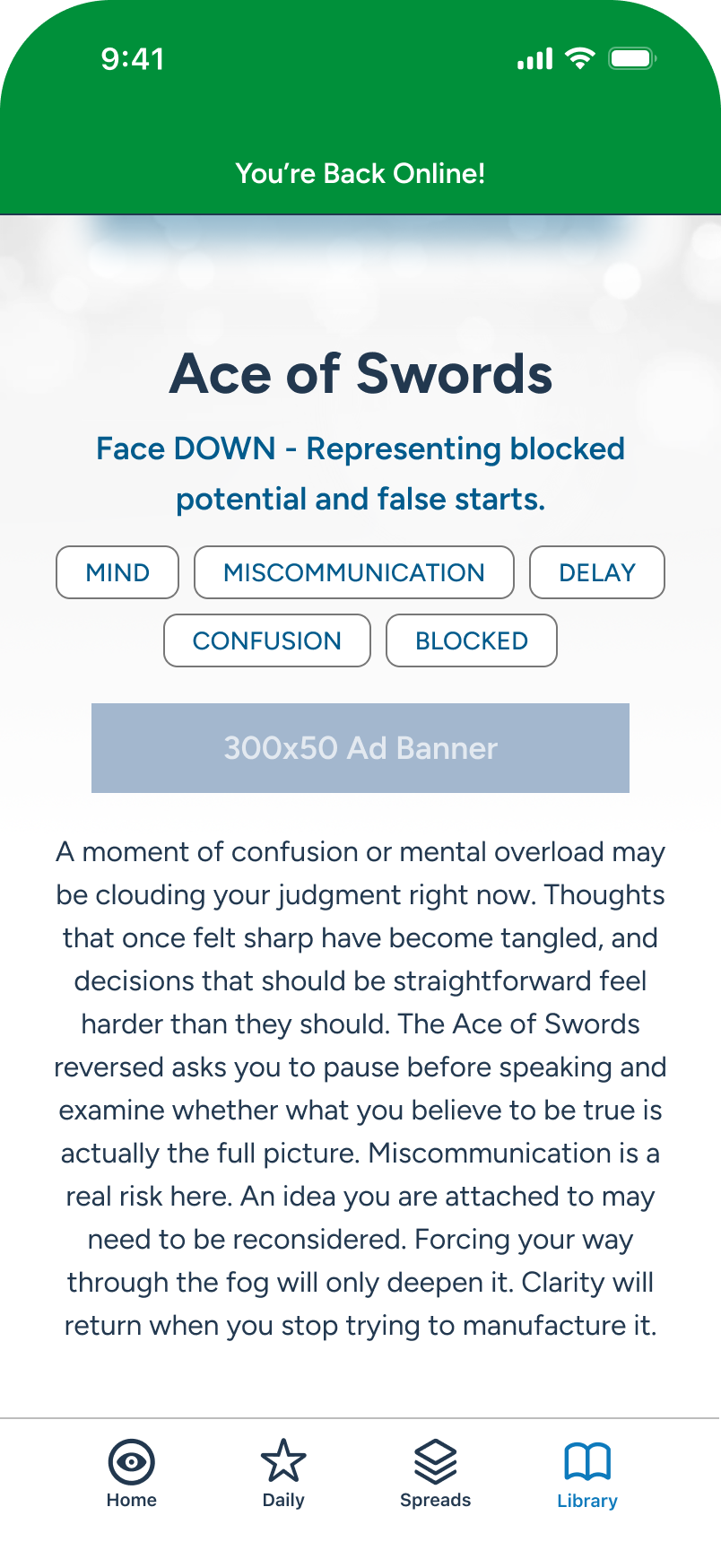
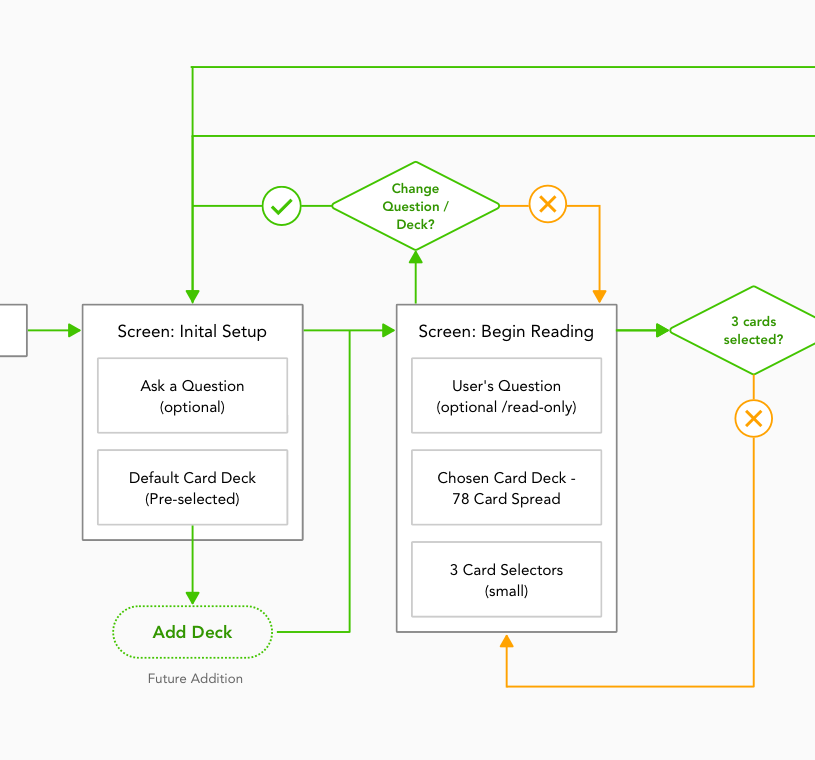
step mapping
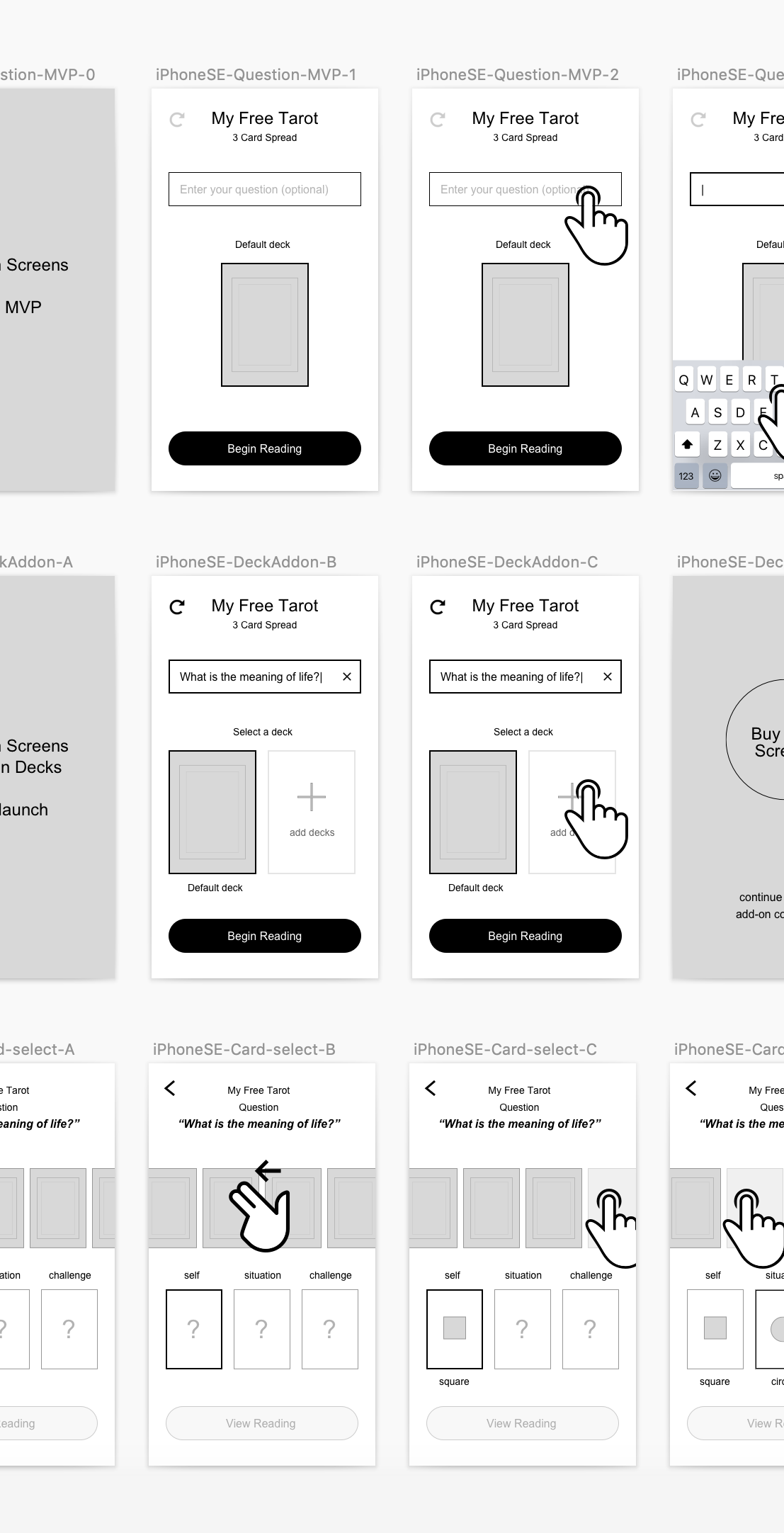
wireframes
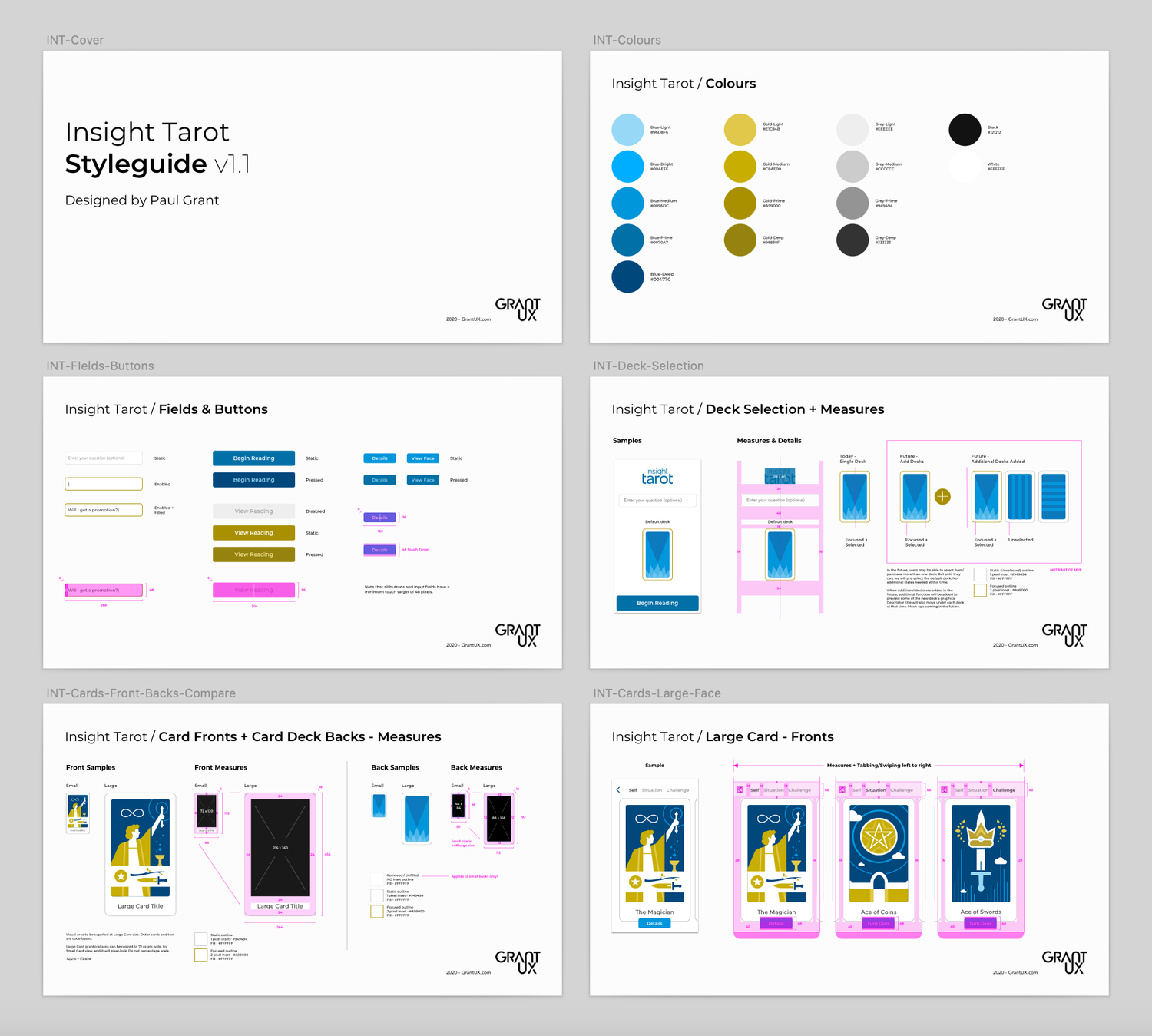
app styleguide
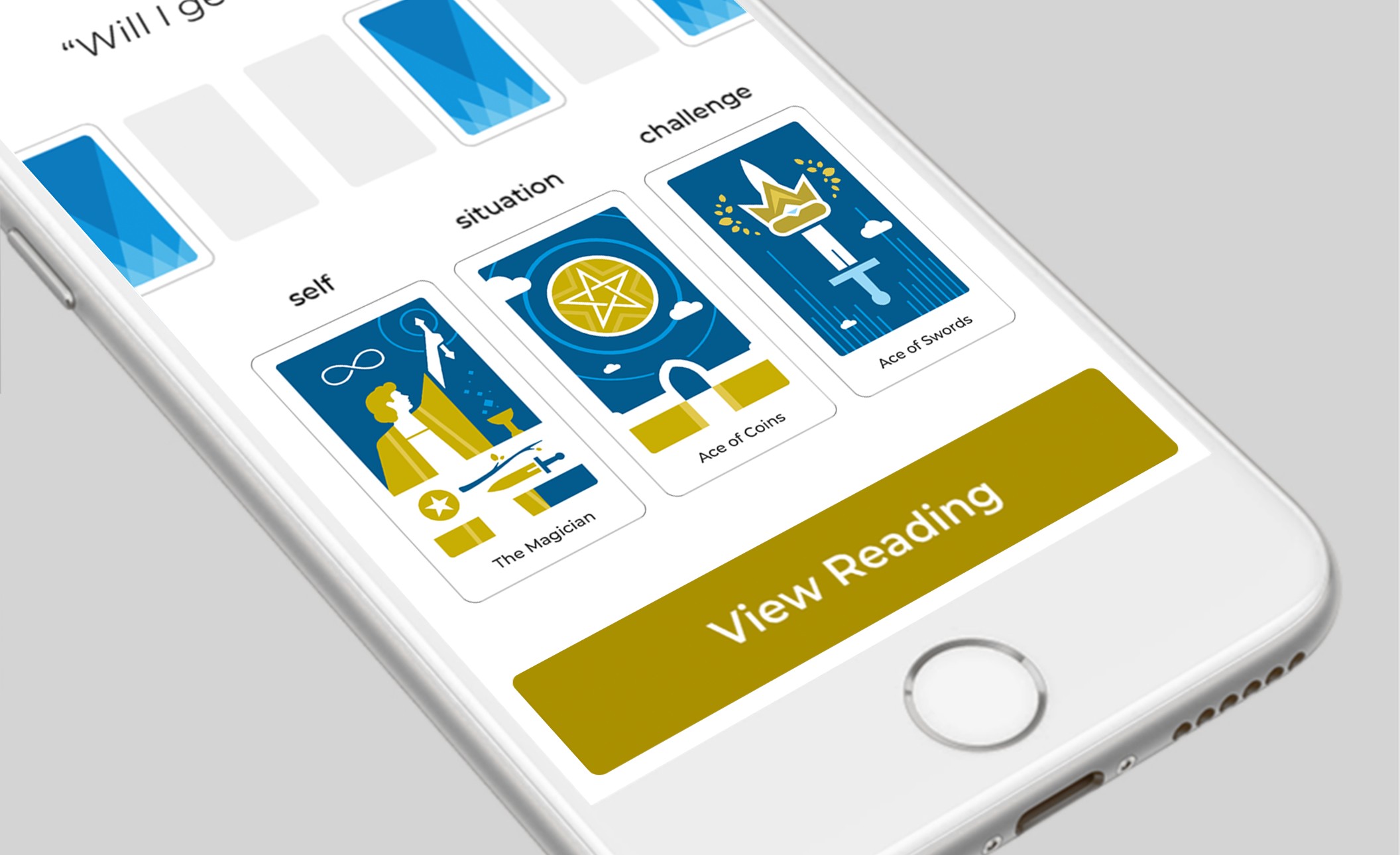
app preview mock

2026 | Current Reboot

After 3 years leading UX at Netomi, an agentic AI company, I started investing time in rebooting the app’s vision through the power and capabilities of vibe coding tools and AI summarization.

Completed

  • Researched the iOS tarot app market and still selected the traditional ritual card draw model (now with AI summarization) for first release, with an AI-driven query kiosk option coming later (see post-MVP upgrades)
  • Built a Gemini GEM interactive agent, successfully producing multi-card summarizations that incorporated reading type, card variables, query, and user focus
  • Built a prototype app using Figma Make AI, and prepared a video walkthrough (available here)
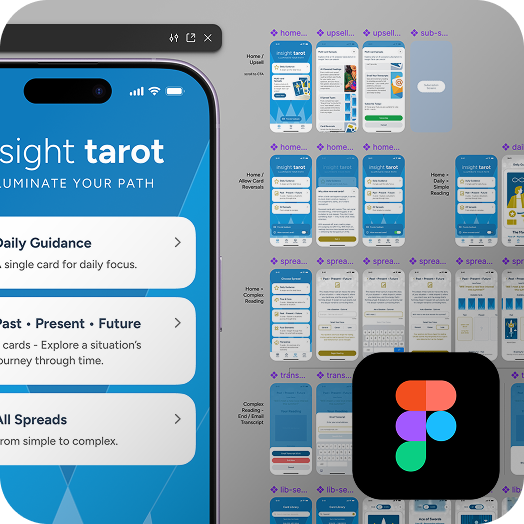
  • Built out all UX screens in Figma, leveraging SF Pro and Phosphor fonts/icons and latest iOS specs
  • Completed the set of 70+ cards using the just-released GPT Image 2, with highest-quality custom vector cards coming post-MVP launch
  • Crafted multiple .CSV guidance documents for Claude Code to follow involving user type and permissions, copy for card descriptors, loading and error messaging, and more
  • Crafted a template for exporting styled multi-card readings into an email-friendly transcript
  • Refined the freemium-to-subscriber model for mvp
  • For a 2 week period, worked with Figma MCP + Claude Code in Terminal + Xcode for development, building out all principal screens and core functions
  • Published the latest user flows and details (here) on GrantUX.com

In Progress - June

  • Clean-up bugs in the Xcode build and hook up external resources
  • Additional graphic clean-up
  • Launch to beta-test

AI summarization for multi-card readings will be gated behind a subscription. The app will be free to install, with single-card Daily Guidance as the freemium entry point. Monetization is supported by inline ads and a subscription upsell for multi-card readings.

paul photo

Throughout my UX career...

...I've built foundations and design systems across enterprise platforms, with storytelling at the centre of my approach. I've designed for government portals and large data-driven cloud tools, and led a UX team at Netomi from the ground up.

To learn more, including my work timeline and continual learning initiatives:

Contact

416.817.4429 | Email Me

Artwork is client-owned and shown solely for creative demonstration.

Website built and published via:

figma sites logo

Insight Tarot - iOS App

A Personal Project

Tarot has been practiced for centuries, evolving from a card game into a widely used tool for reflection and self-guidance. A standard deck contains 78 cards: the 22 Major Arcana, representing life's significant themes and transitions, and the 56 Minor Arcana, covering the everyday influences that shape experience. Today it enjoys broad mainstream appeal, with millions of practitioners worldwide ranging from casual users to dedicated readers.

I've long been drawn to hidden knowledge, deeper meanings, and patterns. After years of using tarot, I Ching, and similar apps, I saw an opportunity in 2020 to combine that interest with my UX and creative background to build something better. The free apps lacked a premium feel, while the paid ones offered better interactions and artwork but at too high a cost. I wanted to strike a middle ground.

The app I envisioned would be free to download but premium in feel, with inline ads supporting a freemium model and a fully custom card deck of over 70 original illustrations at its centre. After auditing the landscape, I mapped core features, a monetization strategy, and a UX framework, culminating in a full style guide and high-fidelity mockups. Ultimately the project was shelved because AI-based summarization didn't exist yet. Now that it does, I'm reinvesting in the app in Spring 2026.

2020 | Initial Project + Pause

  • Investigated the competitive landscape and defined the app's focus and USP
  • In Sketch, built a design system, wireframed interactions, and designed high-fidelity mocks
  • Engaged a developer

The project was shelved due to high development costs and a key limitation: complex, personalized multi-card summarization wasn't yet possible. With over 70 cards in a tarot deck, each carrying its own static meaning, readings couldn't be made truly personal. User queries remained purely symbolic in this earlier iteration.

step mapping
wireframes
app styleguide
app preview mock

2026 | Current Reboot

After 3 years leading UX at Netomi, an agentic AI company, I started investing time in rebooting the app’s vision through the power and capabilities of vibe coding tools and AI summarization.

Completed

  • Researched the iOS tarot app market and still selected the traditional ritual card draw model (now with AI summarization) for first release, with an AI-driven query kiosk option coming later (see post-MVP upgrades)
  • Built a Gemini GEM interactive agent, successfully producing multi-card summarizations that incorporated reading type, card variables, query, and user focus
  • Built a prototype app using Figma Make AI, and prepared a video walkthrough (available here)
  • Built out all UX screens in Figma, leveraging SF Pro and Phosphor fonts/icons and latest iOS specs
  • Completed the set of 70+ cards using the just-released GPT Image 2, with highest-quality custom vector cards coming post-MVP launch
  • Crafted multiple .CSV guidance documents for Claude Code to follow involving user type and permissions, copy for card descriptors, loading and error messaging, and more
  • Crafted a template for exporting styled multi-card readings into an email-friendly transcript
  • Refined the freemium-to-subscriber model for mvp
  • For a 2 week period, worked with Figma MCP + Claude Code in Terminal + Xcode for development, building out all principal screens and core functions
  • Published the latest user flows and details (here) on GrantUX.com

In Progress - June

  • Clean-up bugs in the Xcode build and hook up external resources
  • Additional graphic clean-up
  • Launch to beta-test

AI summarization for multi-card readings will be gated behind a subscription. The app will be free to install, with single-card Daily Guidance as the freemium entry point. Monetization is supported by inline ads and a subscription upsell for multi-card readings.

paul photo

Contact

416.817.4429 | Email Me

Artwork is client-owned and shown solely for creative demonstration.

Throughout my UX career...

...I've built foundations and design systems across enterprise platforms, with storytelling at the centre of my approach. I've designed for government portals and large data-driven cloud tools, and led a UX team at Netomi from the ground up.

To learn more, including my work timeline and continual learning initiatives:

Website built and published using Figma Sites

figma sites logo

Insight Tarot - iOS App

A Personal Project

Tarot has been practiced for centuries, evolving from a card game into a widely used tool for reflection and self-guidance. A standard deck contains 78 cards: the 22 Major Arcana, representing life's significant themes and transitions, and the 56 Minor Arcana, covering the everyday influences that shape experience. Today it enjoys broad mainstream appeal, with millions of practitioners worldwide ranging from casual users to dedicated readers.

I've long been drawn to hidden knowledge, deeper meanings, and patterns. After years of using tarot, I Ching, and similar apps, I saw an opportunity in 2020 to combine that interest with my UX and creative background to build something better. The free apps lacked a premium feel, while the paid ones offered better interactions and artwork but at too high a cost. I wanted to strike a middle ground.

The app I envisioned would be free to download but premium in feel, with inline ads supporting a freemium model and a fully custom card deck of over 70 original illustrations at its centre. After auditing the landscape, I mapped core features, a monetization strategy, and a UX framework, culminating in a full style guide and high-fidelity mockups. Ultimately the project was shelved because AI-based summarization didn't exist yet. Now that it does, I'm reinvesting in the app in Spring 2026.

Review Structure

  • Evolution – From 2020 concept to 2026 reboot: the constraint that blocked it, and how AI solved it.
  • Demo – A link to a Figma Make video walk-through, featuring AI-generated summaries in action.
  • MVP Figma Flows – Sectional flows detailing features, interactions, states, error handing, and more.
  • Post-MVP Upgrades – Glimpse what's next: new features to scale into emerging markets, and more.
  • Post-MVP User Tiers – A projected look at Freemium > Subscriber Plus > Subscriber Pro tiers.
  • 2026 Market Summary – $9B by 2030, 120M+ users, AI-personalization driving growth, and more.

Duration:

2026 (Active)

Consumer

AI Personalization

Mobile

0-1

2020

Initial Project + Pause

  • Investigated the competitive landscape and defined the app's focus and USP
  • In Sketch, built a design system, wireframed interactions, and designed high-fidelity mocks
  • Engaged a developer

The project was shelved due to high development costs and a key limitation: complex, personalized multi-card summarization wasn't yet possible. With over 70 cards in a tarot deck, each carrying its own static meaning, readings couldn't be made truly personal. User queries remained purely symbolic in this earlier iteration.

step mapping
wireframes
app styleguide
app preview mock

2026

Current Reboot

After 3 years leading UX at Netomi, an agentic AI company, I started investing time in rebooting the app’s vision through the power and capabilities of vibe coding tools and AI summarization.

Completed

  • Researched the iOS tarot app market and still selected the traditional ritual card draw model (now with AI summarization) for first release, with an AI-driven query kiosk option coming later (see post-MVP upgrades)
  • Built a Gemini GEM interactive agent, successfully producing multi-card summarizations that incorporated reading type, card variables, query, and user focus
  • Built a prototype app using Figma Make AI, and prepared a video walkthrough (available here)
  • Built out all UX screens in Figma, leveraging SF Pro and Phosphor fonts/icons and latest iOS specs
  • Completed the set of 70+ cards using the just-released GPT Image 2, with highest-quality custom vector cards coming post-MVP launch
  • Crafted multiple .CSV guidance documents for Claude Code to follow involving user type and permissions, copy for card descriptors, loading and error messaging, and more
  • Crafted a template for exporting styled multi-card readings into an email-friendly transcript
  • Refined the freemium-to-subscriber model for mvp
  • For a 2 week period, worked with Figma MCP + Claude Code in Terminal + Xcode for development, building out all principal screens and core functions
  • Published the latest user flows and details (here) on GrantUX.com

In Progress - June

  • Clean-up bugs in the Xcode build and hook up external resources
  • Additional graphic clean-up
  • Launch to beta-test

AI summarization/personalization for multi-card readings will be gated behind a subscription. The app will be free to install, with single-card Daily Guidance as the freemium entry point. Monetization is supported by inline ads and a subscription upsell for multi-card readings.

Figma Make video demo walk-through and latest Figma-based user flows below

Onboard Screens: Defining the Key Sections

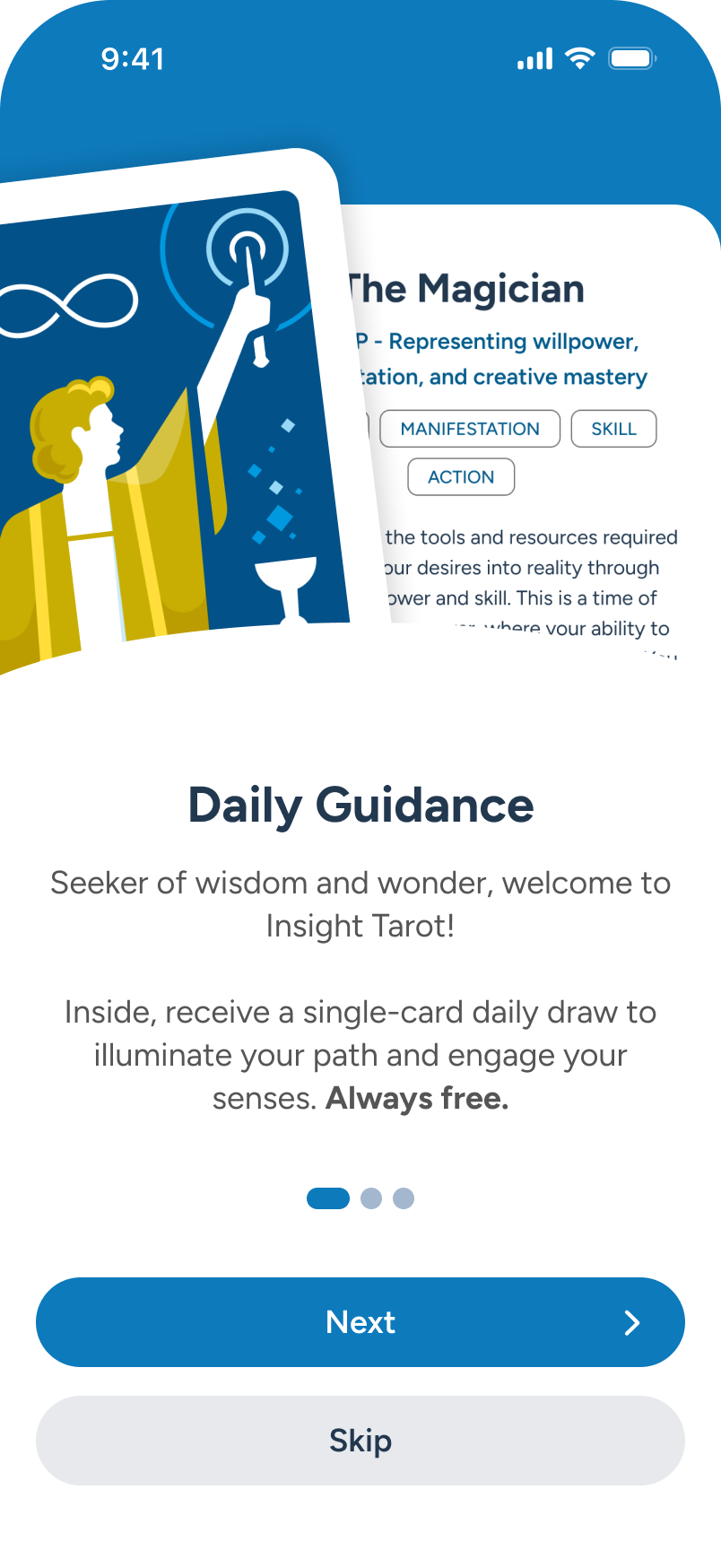
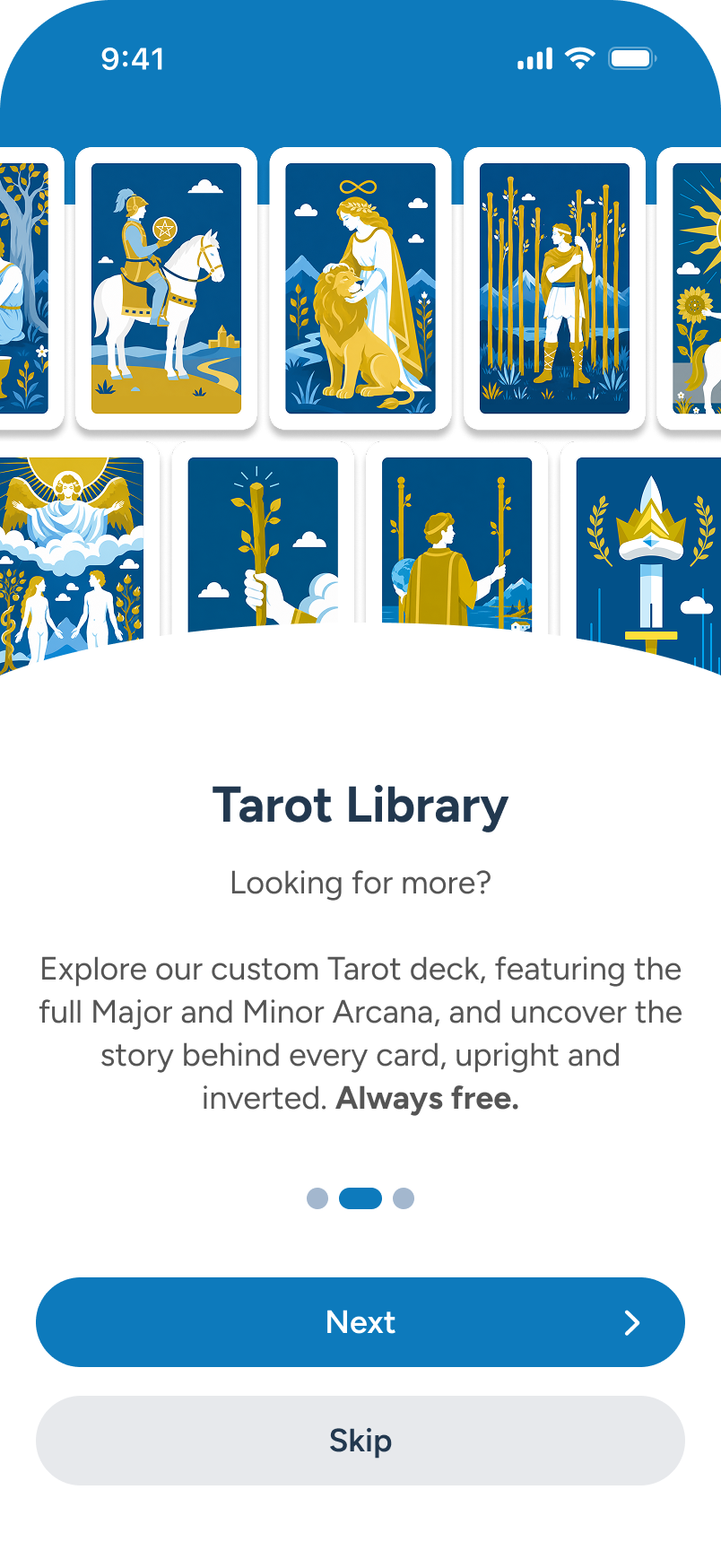
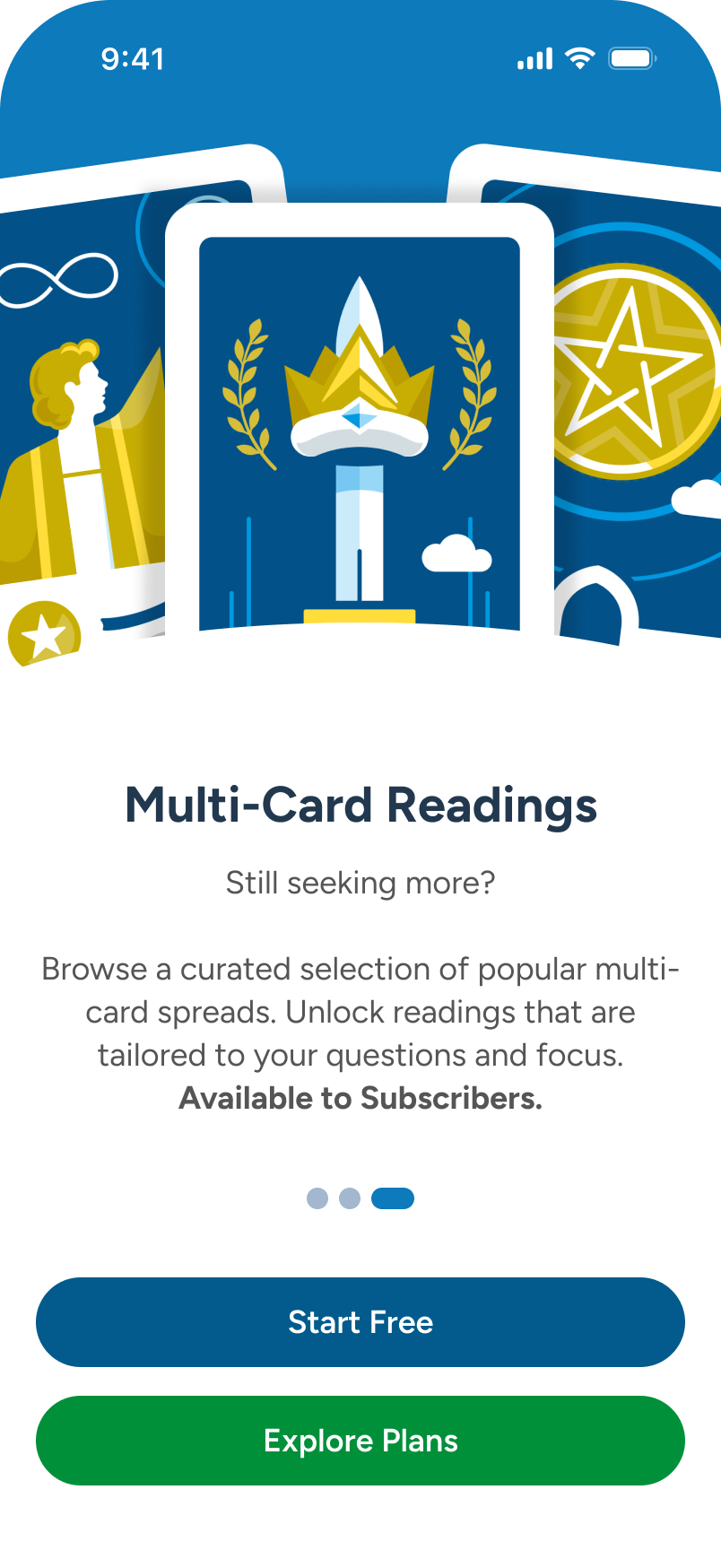
On first install, the app walks new users through its three core sections before landing on a conversion prompt. The flow is linear and swipeable, with a skip option available throughout. Free features are introduced first, Daily Guidance and the Tarot Library, with Multi-Card Readings closing the sequence as the subscriber payoff.

Note: We will review the Plan screens later in the flow. For now, we’ll proceed to the standard view for the freemium Basic tier. Post-onboard policy agreement flows not shown here, but can be discussed in a review call.

Loading screen is splashed for a few seconds as the application loads.

Here, Daily Guidance introduces the free single-card draw, the freemium anchor of the experience. “Next.”

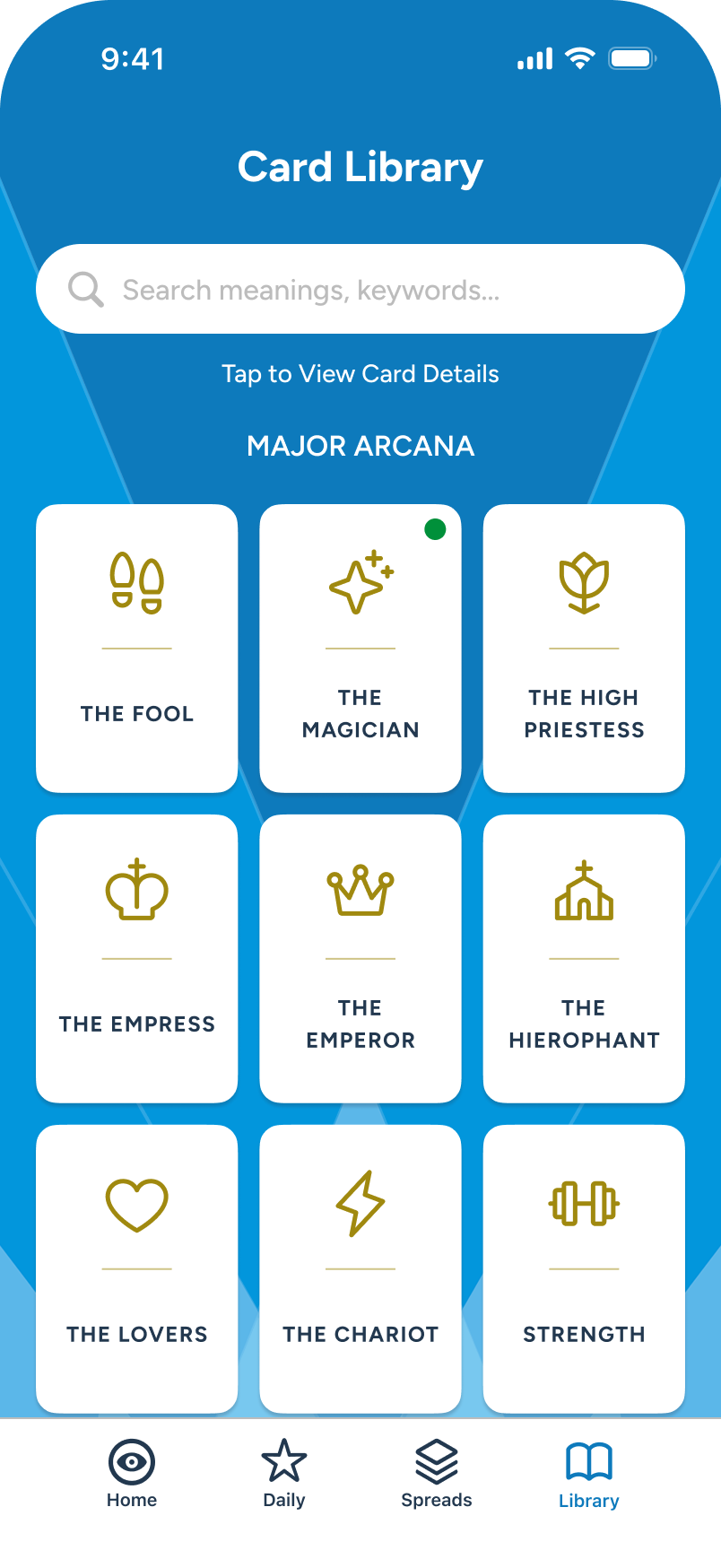
Tarot Library presents the full 78-card deck, free to explore for all users. “Next.”

Last, Multi-Card Readings closes the flow with the subscriber value prop and a clear two-CTA exit.

The Multi-Card Upsell: Another avenue to conversion

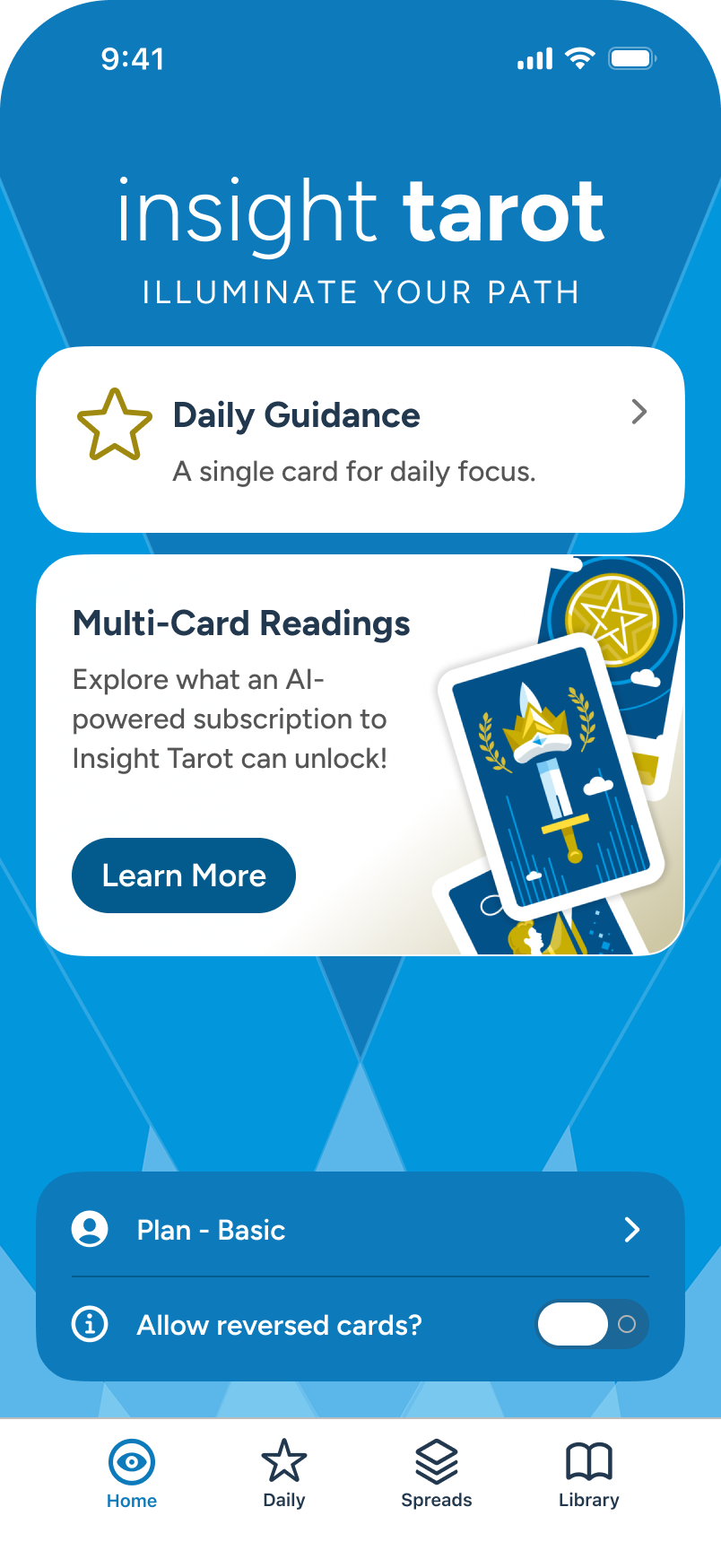
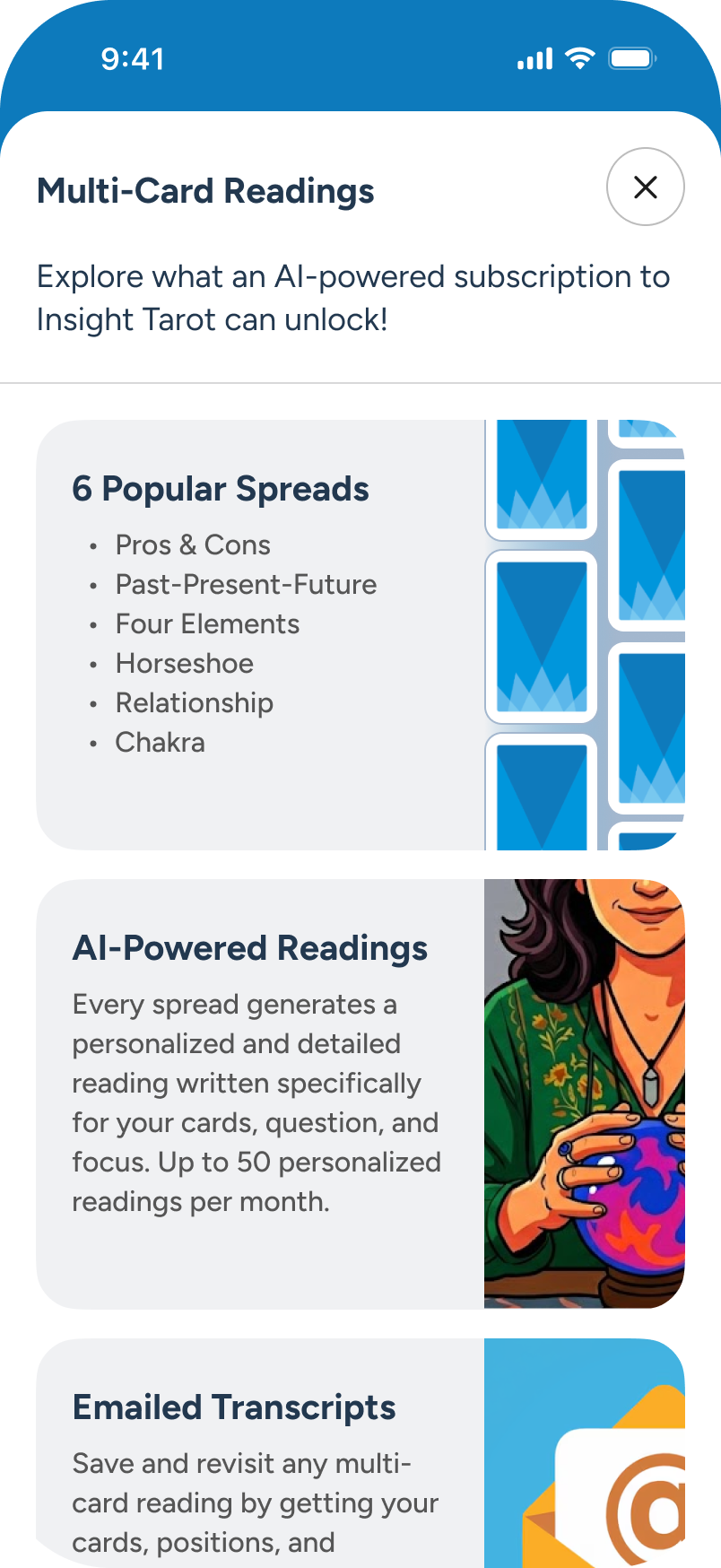
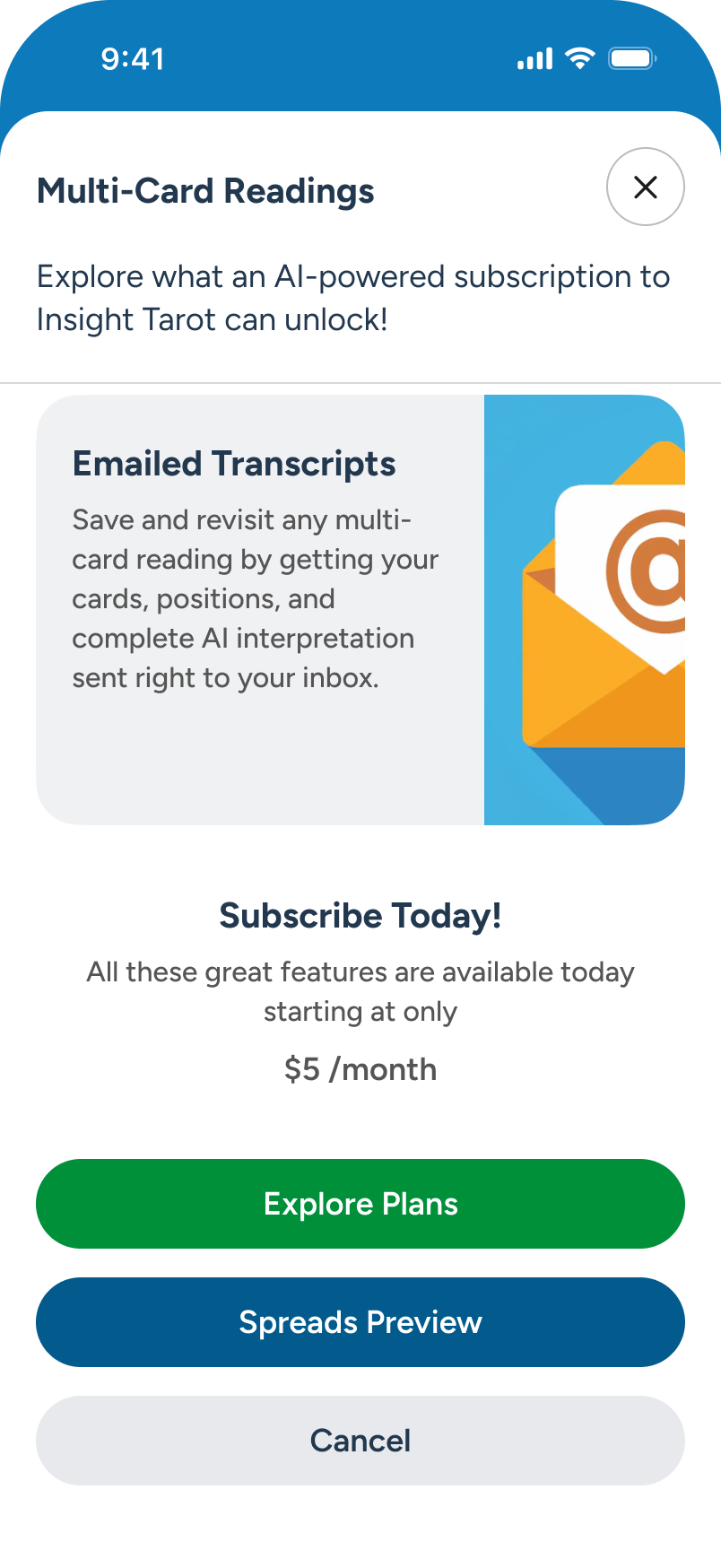
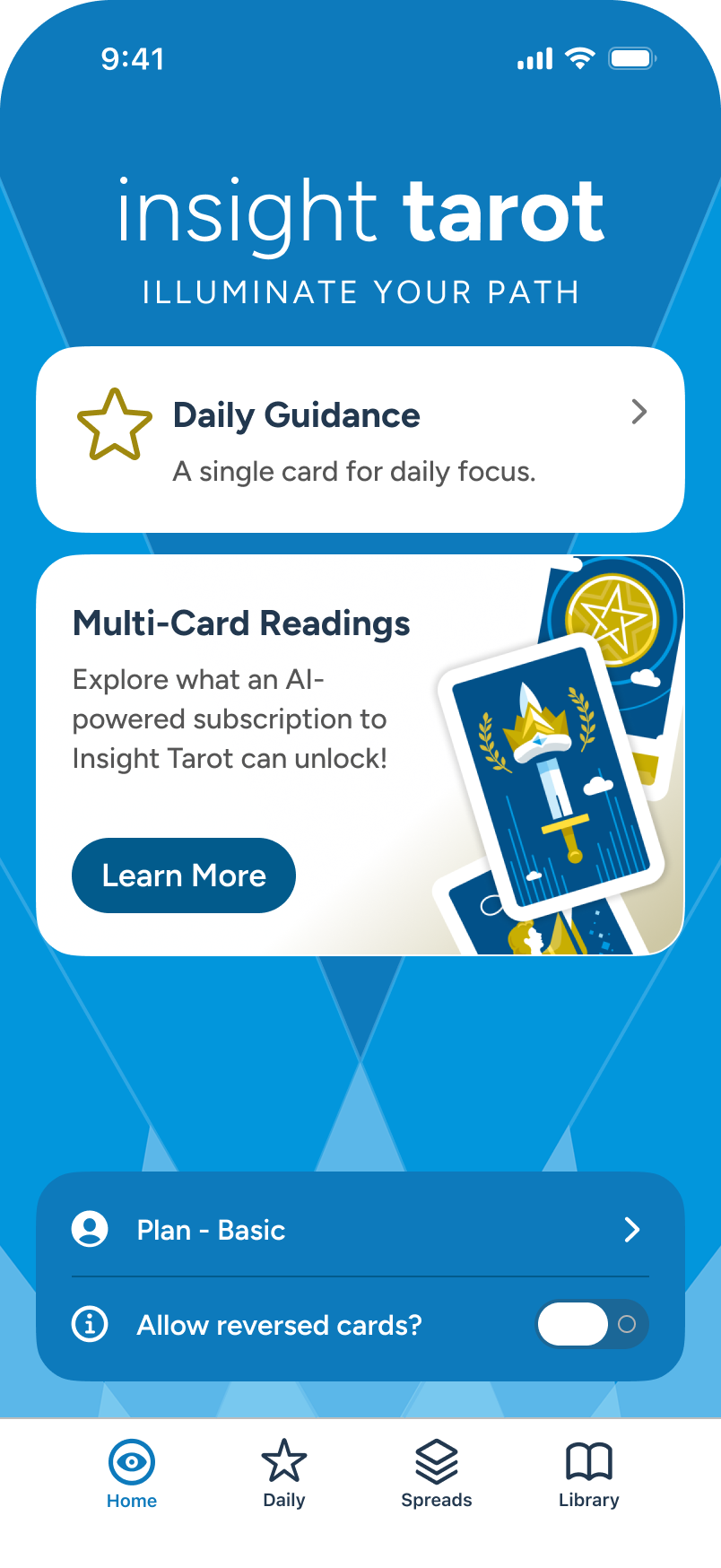
A freemium user on the Home screen encounters an ad card promoting Multi-Card Readings. Tapping it launches a feature overlay detailing what a subscription unlocks. The overlay offers two exits: upgrade immediately via Explore Plans, or browse the locked Spreads section -- a low-friction second path to the same conversion goal.

Note: The promo overlay offers two paths — proceed to Plan for immediate upgrade, or explore the locked Spreads section, which also links back to Plan.

From Home, user taps on “Multi-Card Readings” ad card, to learn more about the advanced options for subscribers.

An overlay appears, detailing multiple improvements a subscription would provide.

At the bottom of the overlay, the user sees the base pricing and chooses to proceed via “Explore Plans” CTA.

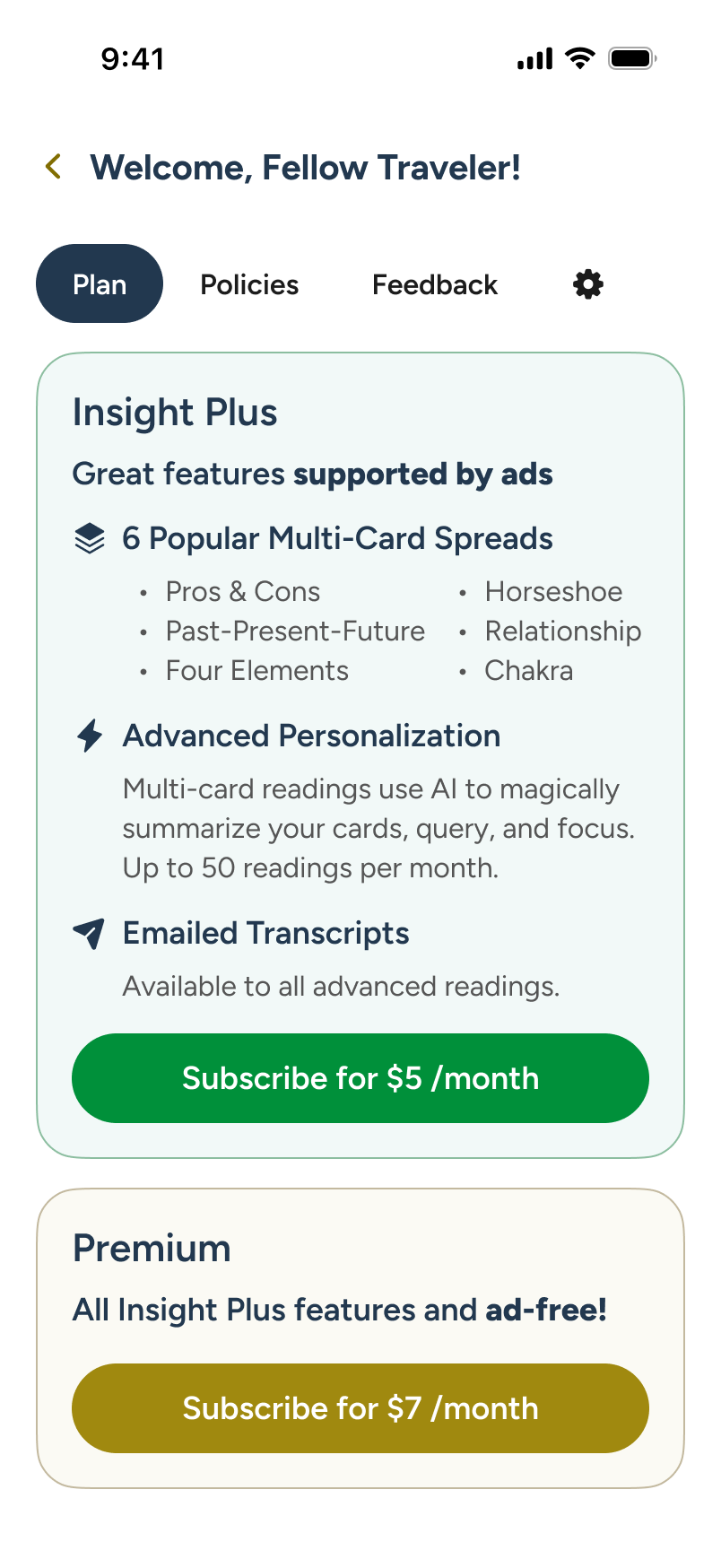
The overlay closes, and conversion options under the User Hub / Plan area come up - Next screens.

User Hub: Reviewing Plan / Policies / Feedback

The new user has been enjoying the free (Basic) plan of Insight Tarot, accessing the Daily Guidance single-card draw on several occasions. They decide to explore the User Hub section, from Home, to review additional options and updates. Ultimately, they choose to submit some feedback, further down.

Note: Full flows for all plan scenarios not included in this review. For Settings, review access from Daily Guidance section.

The user selects “Plan - Basic” CTA option.

The user lands on upgrade options under “Plan”. After a brief review, they continue on to “Policies”, at top.

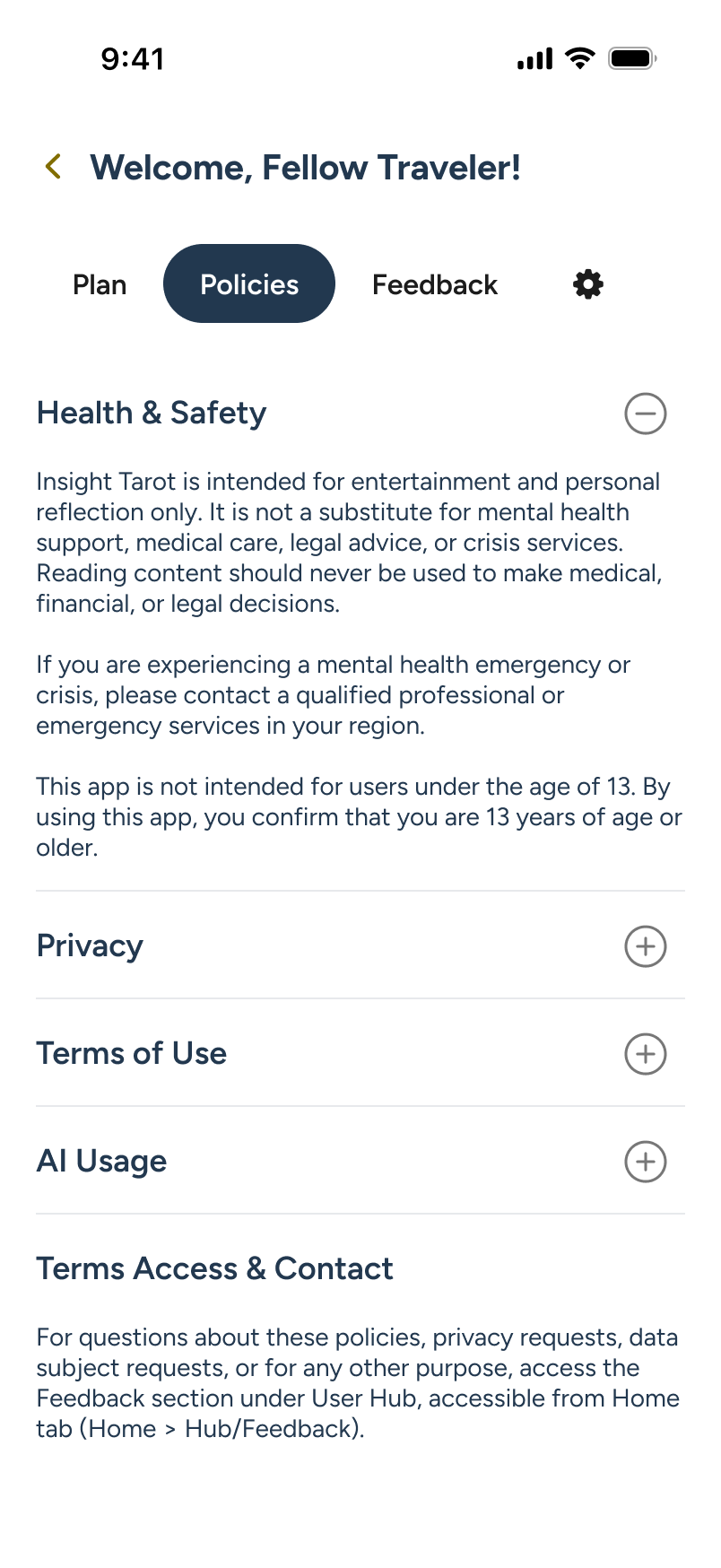
The user reviews legal statements on health, privacy, and more. We continue on to “Feedback”.

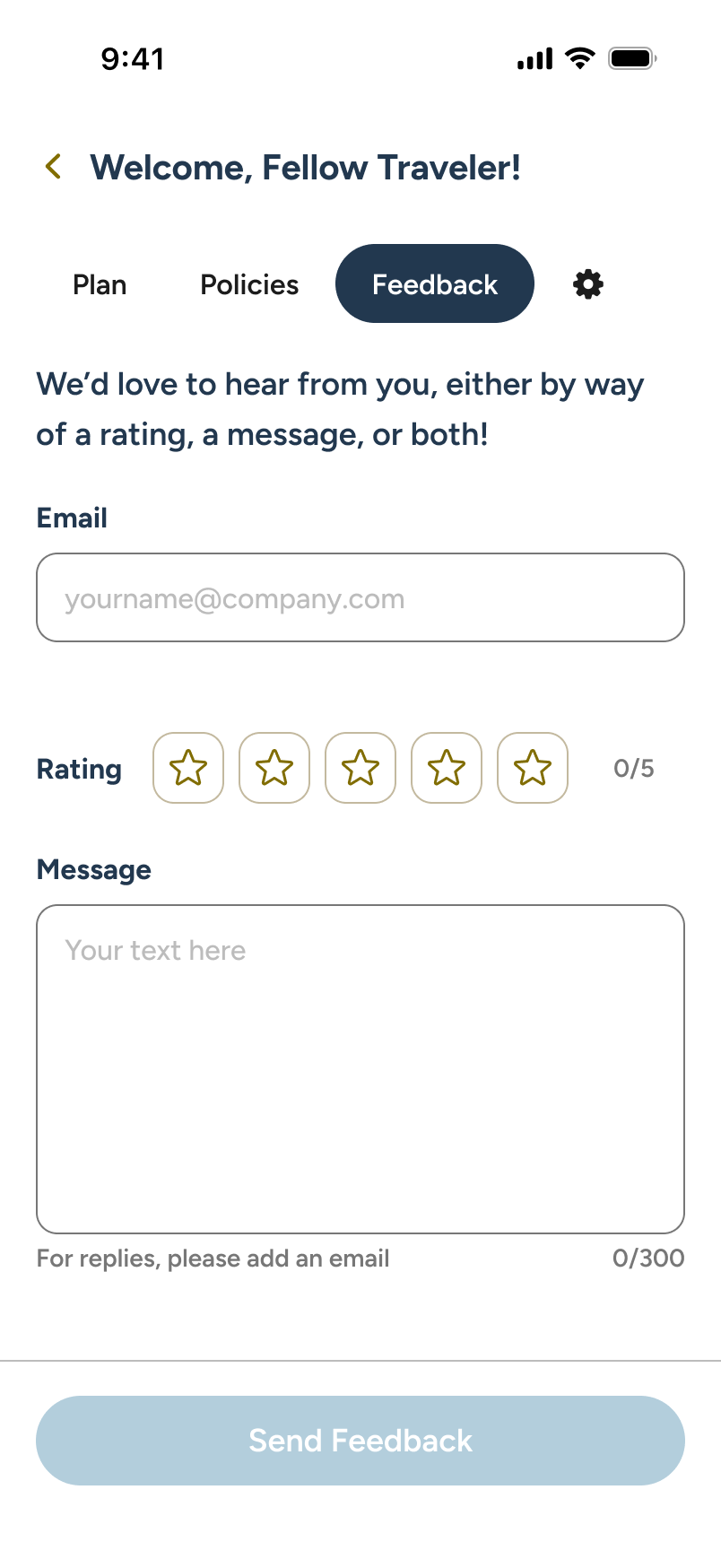
The user is reviewing the feedback form. Below, we’ll take a look as the user decides to fill it out and submit.

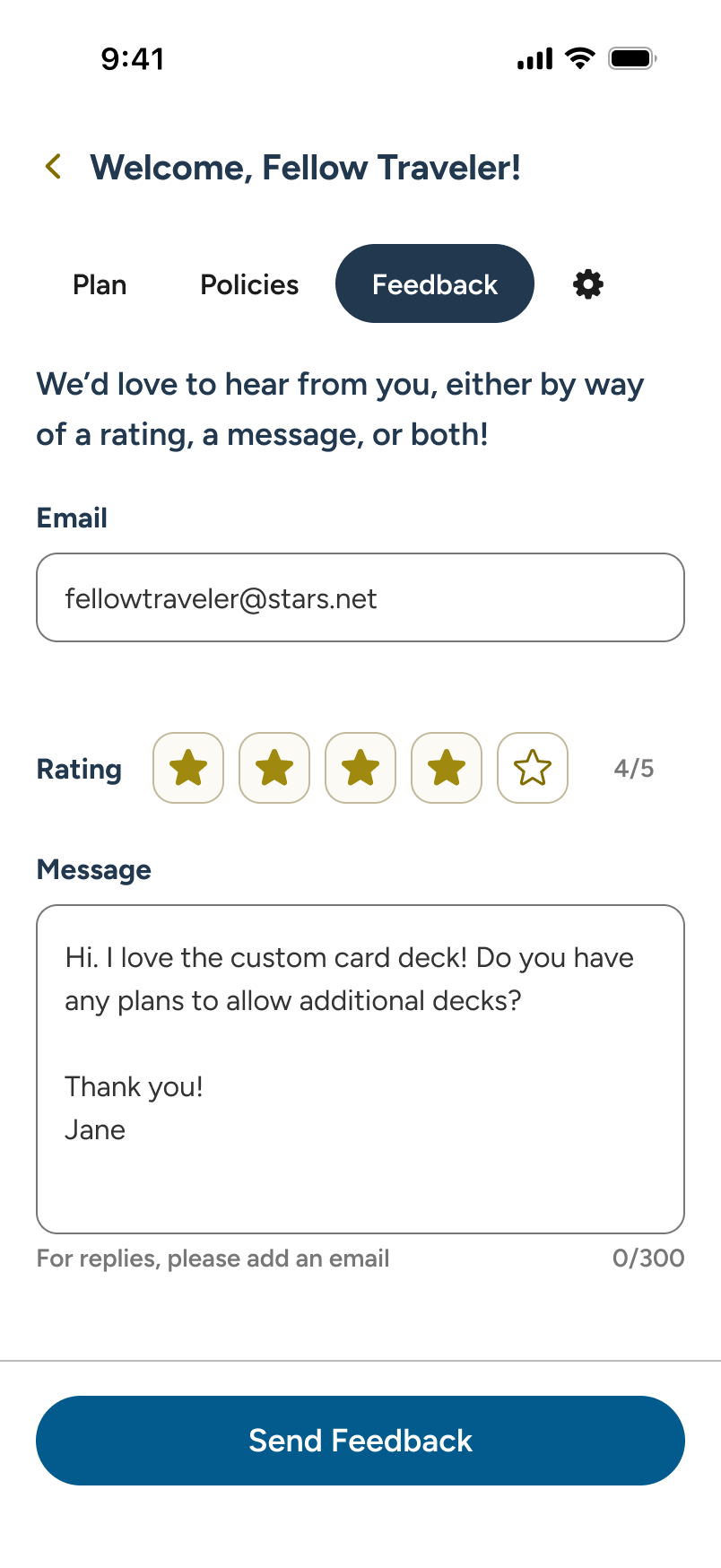
Jumping ahead, our user has filled all fields and, with the KB cleared, taps the “Send Feedback” CTA to proceed.

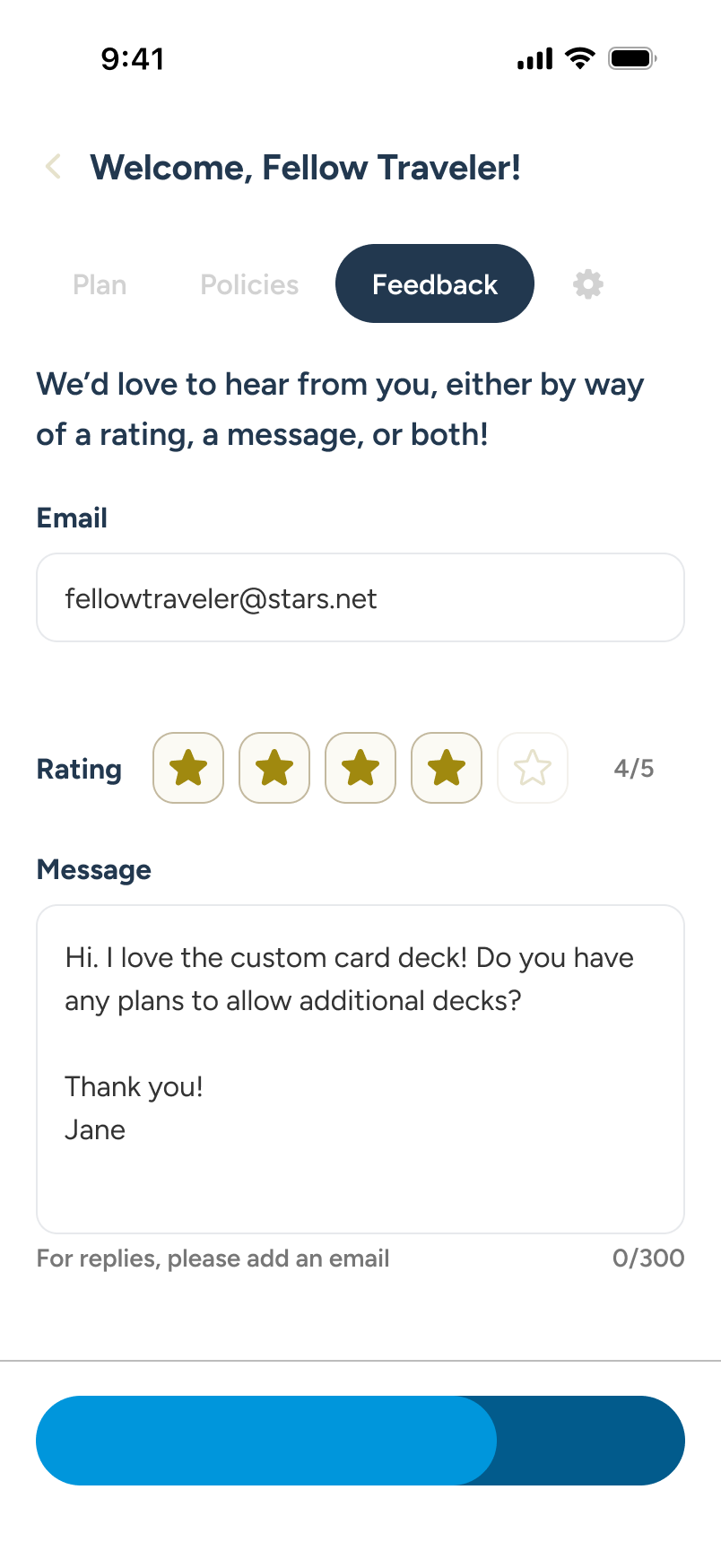
Interactive content temporarily moves to a read-only state as the CTA turns into a send progression bar.

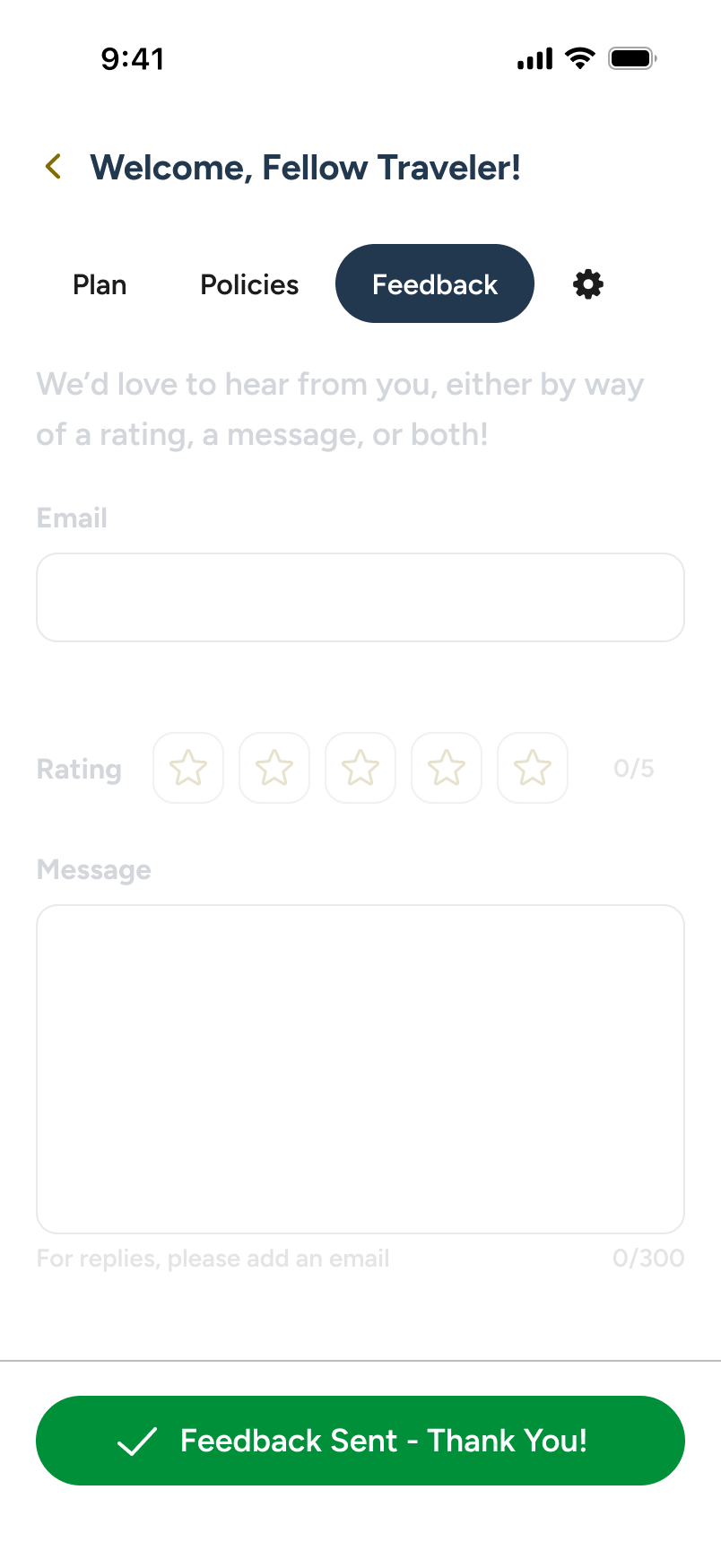
Success! Feedback sent. Controls return and the form is session disabled. User proceeds to Home.

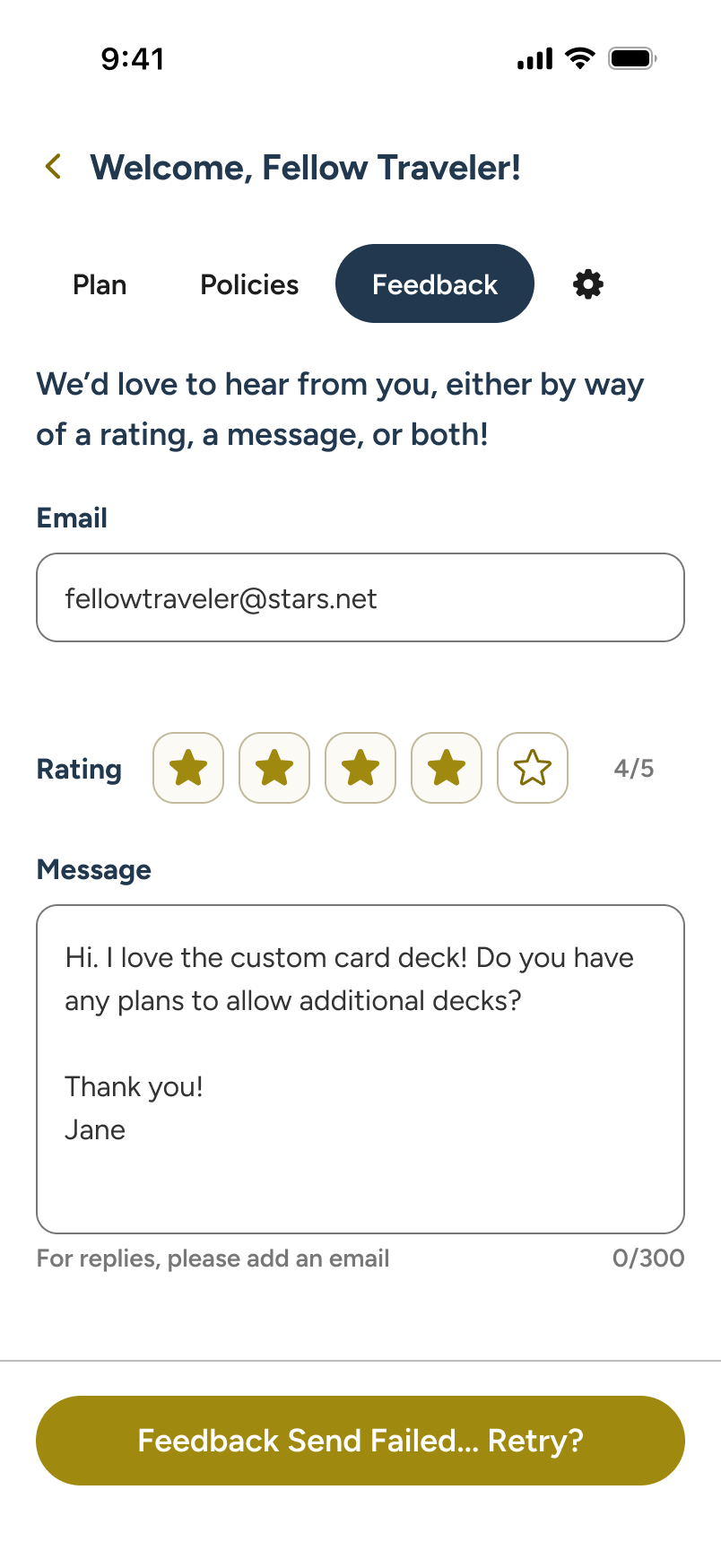
Send failed. User receives filled form back to try sending again. Next steps? Modal warn if user abandons form.

Subscribed Home: Enabling Card Reversals

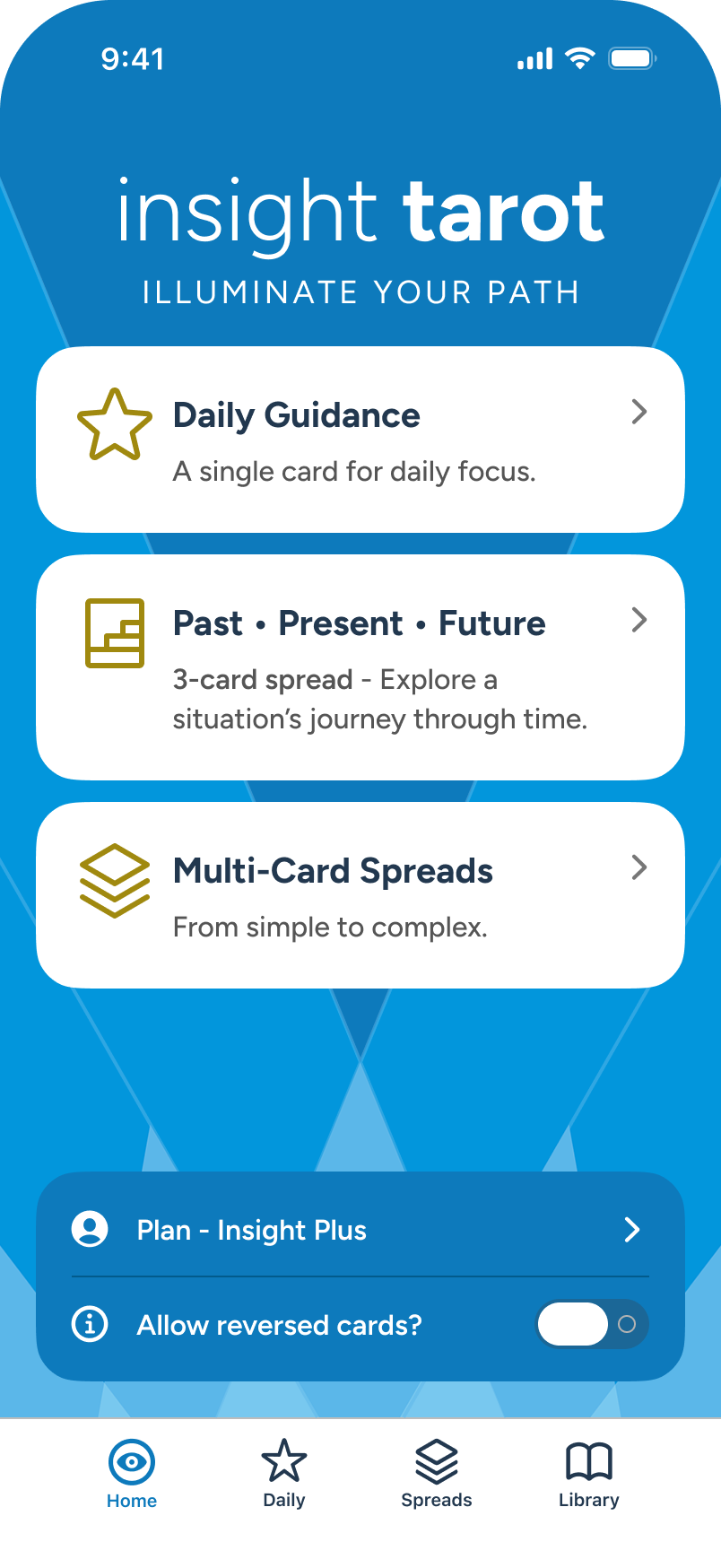
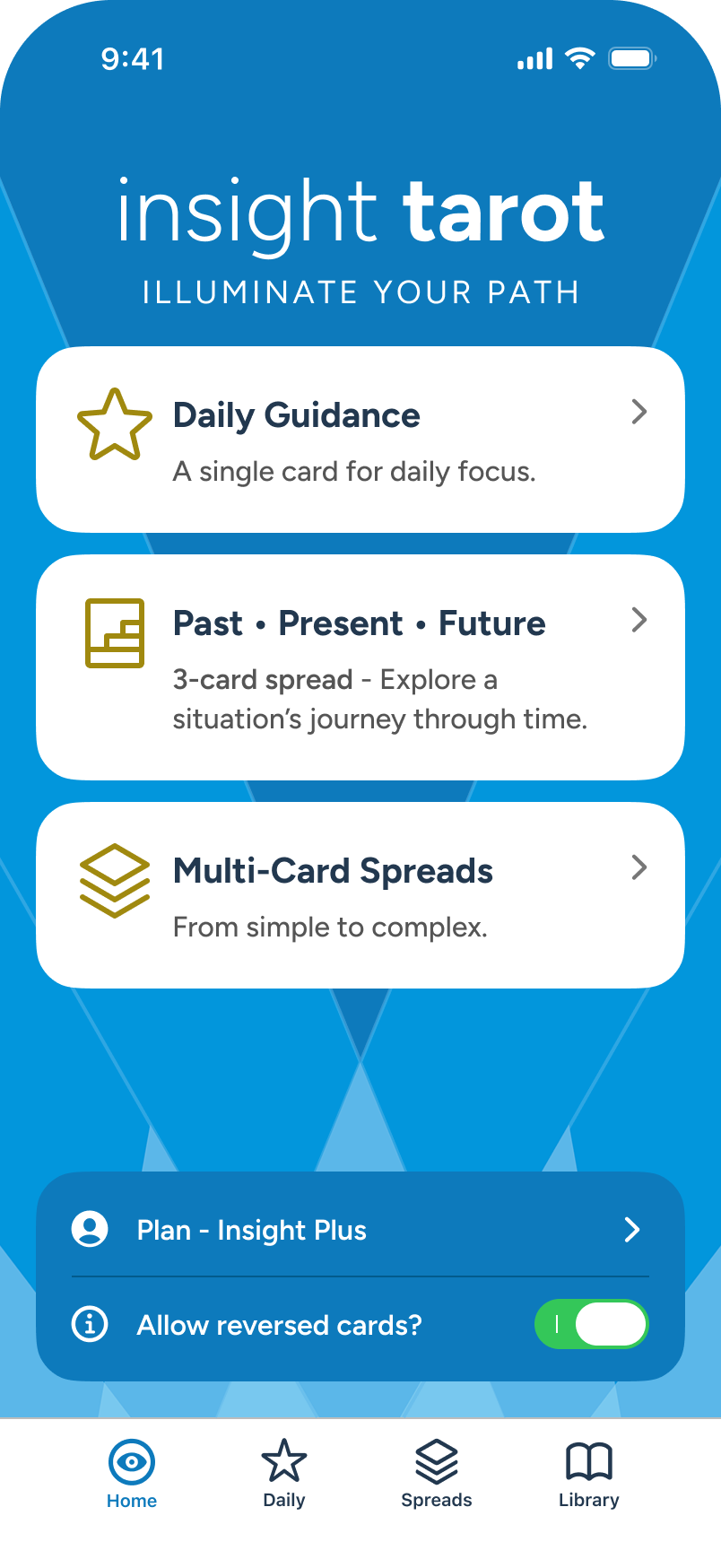
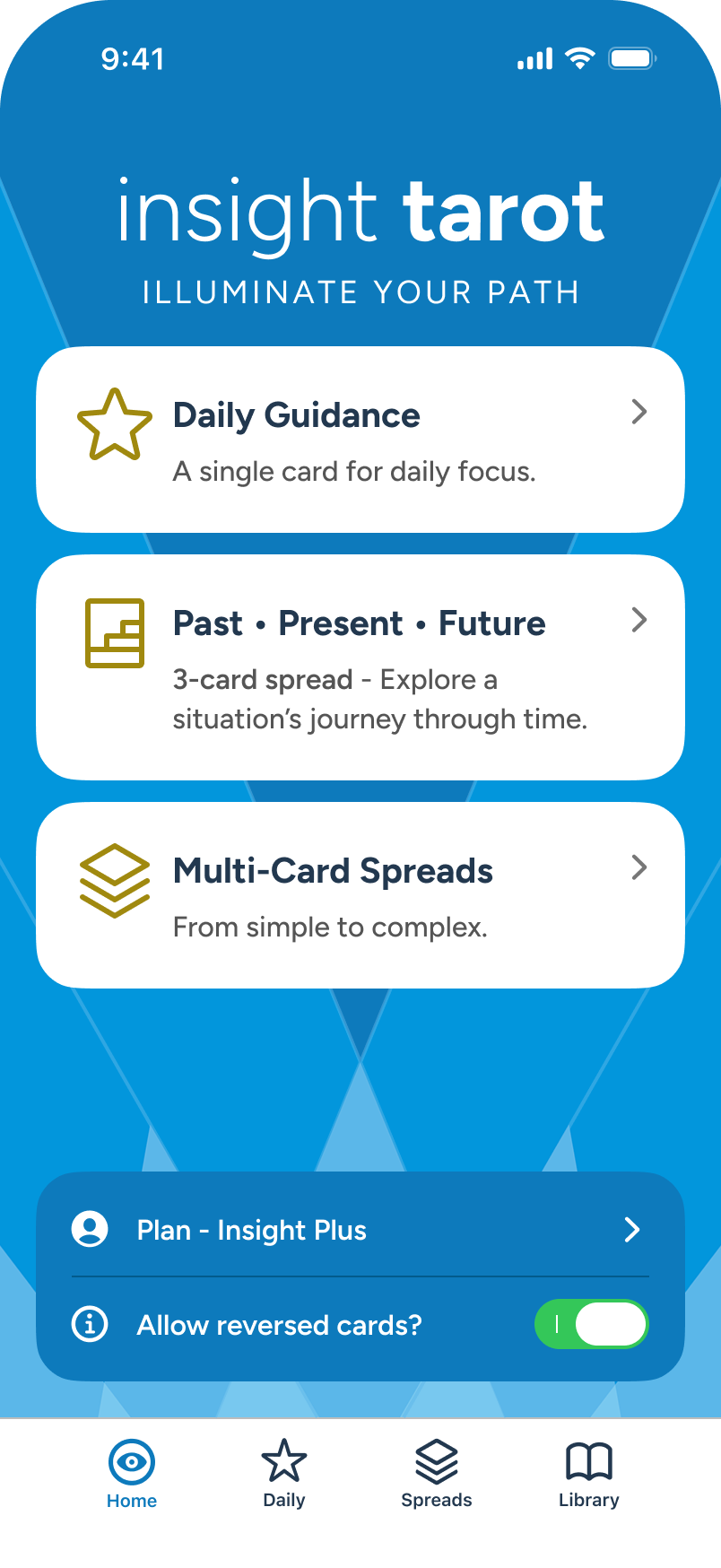
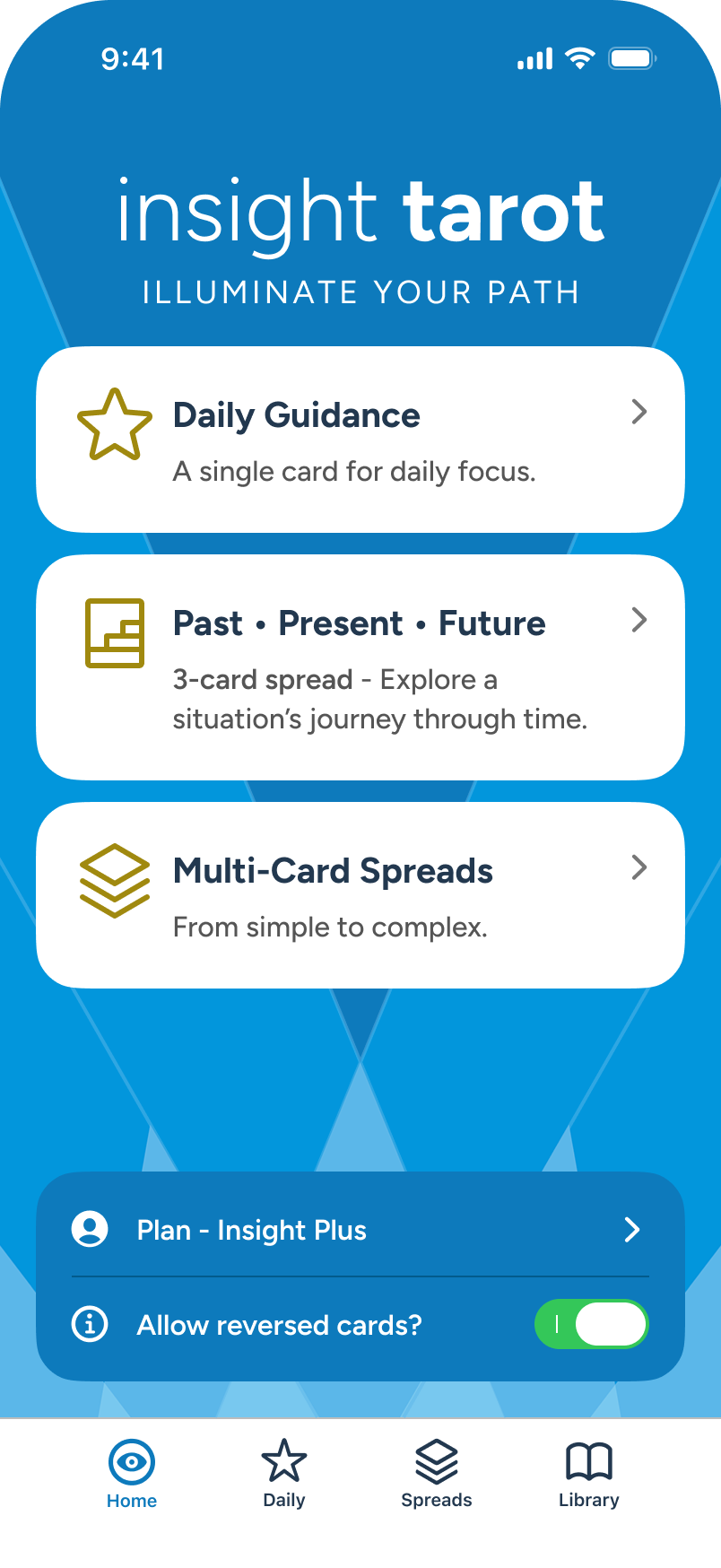
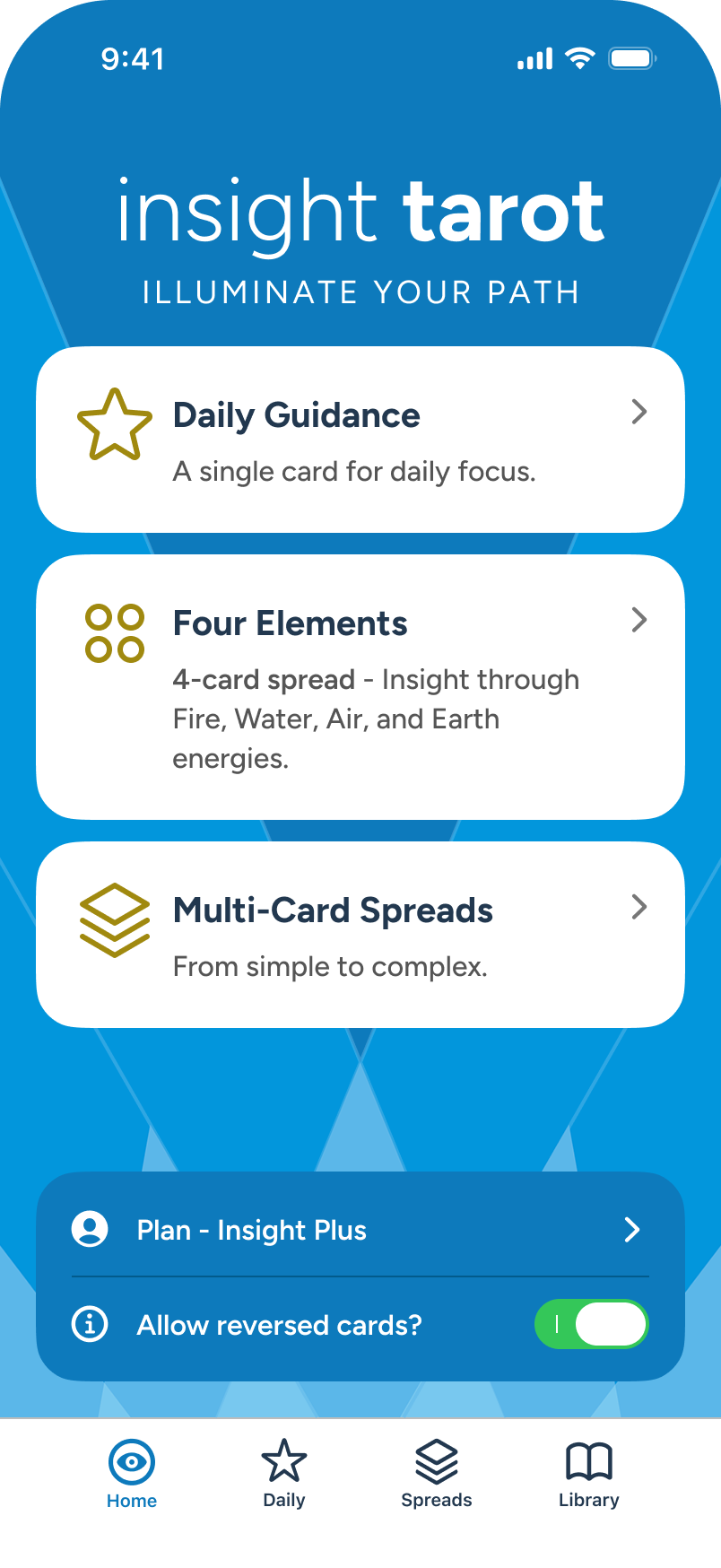
Once subscribed, the Home screen gains direct access to all multi-card spreads (with AI summarization) and a pinned "Past • Present • Future" spread as an advanced alternative to "Daily Guidance." Both features will be explored shortly.

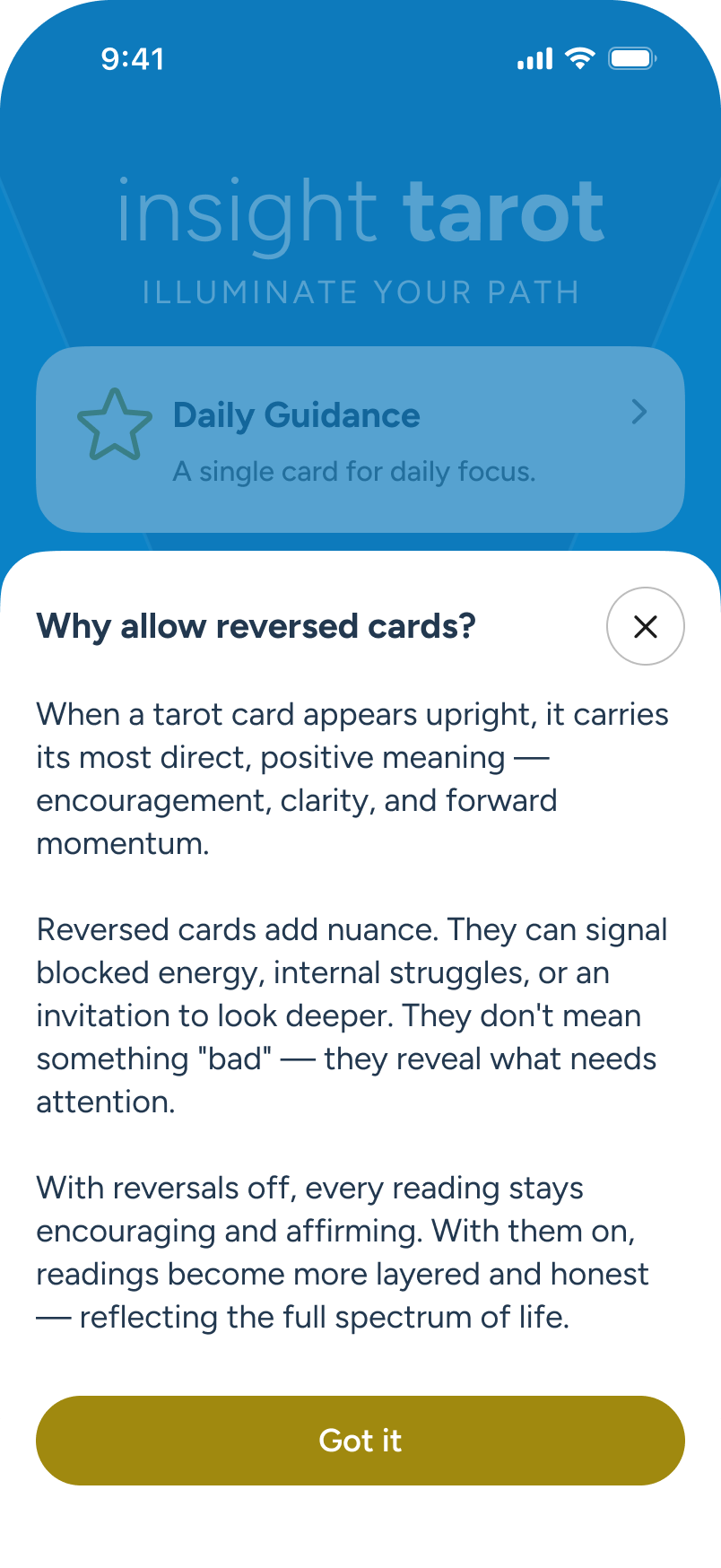
In this flow, the user sees a toggle that enables reversed cards in all readings. They tap the info icon to understand how this feature adds nuance to spread interpretations, then they activate it.

In the subscribed Home screen, the user explores card reversals and taps “info” icon.

An overlay conveys the benefits of allowing card reversals in all readings.

Returning to Home, the user decides to enable the feature via toggle.

Daily Guidance: Single Card Draw

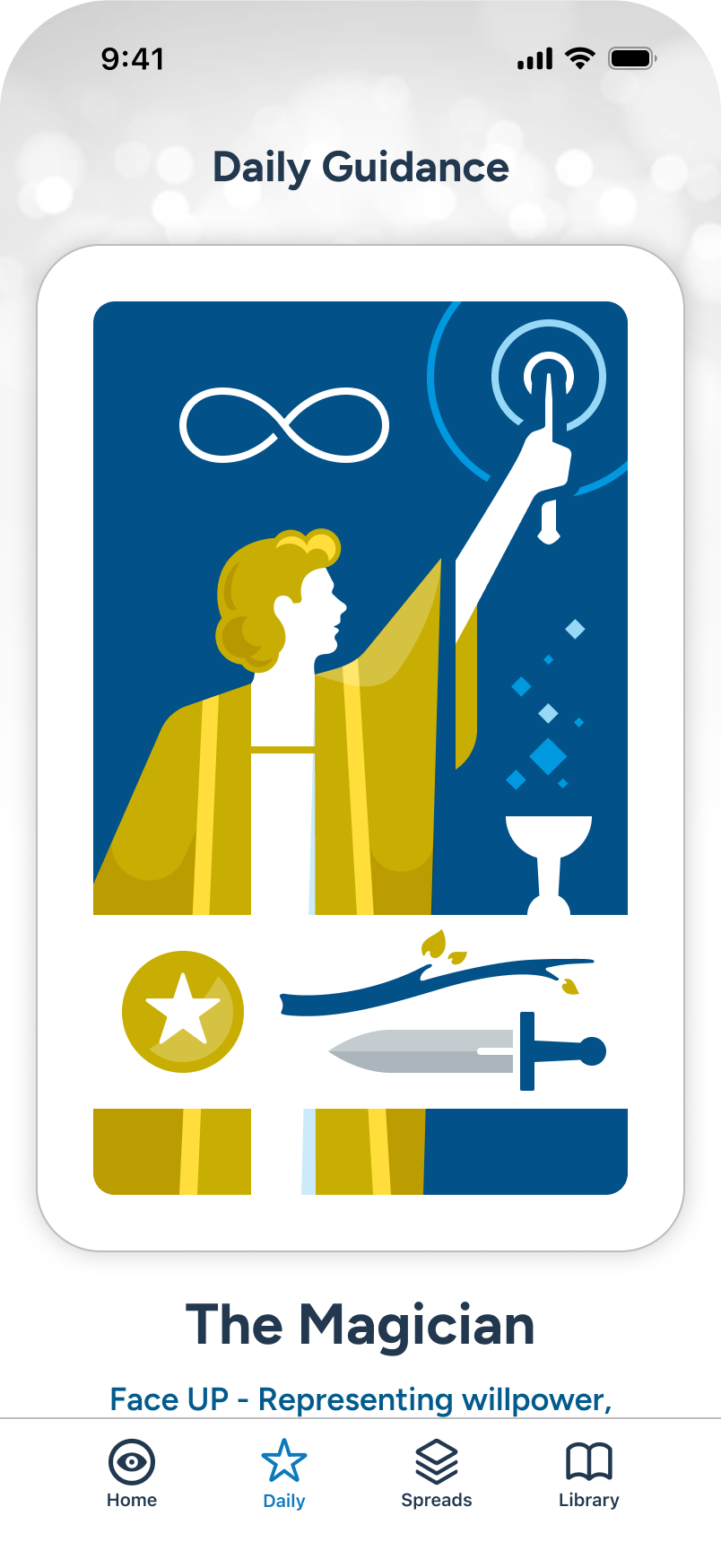
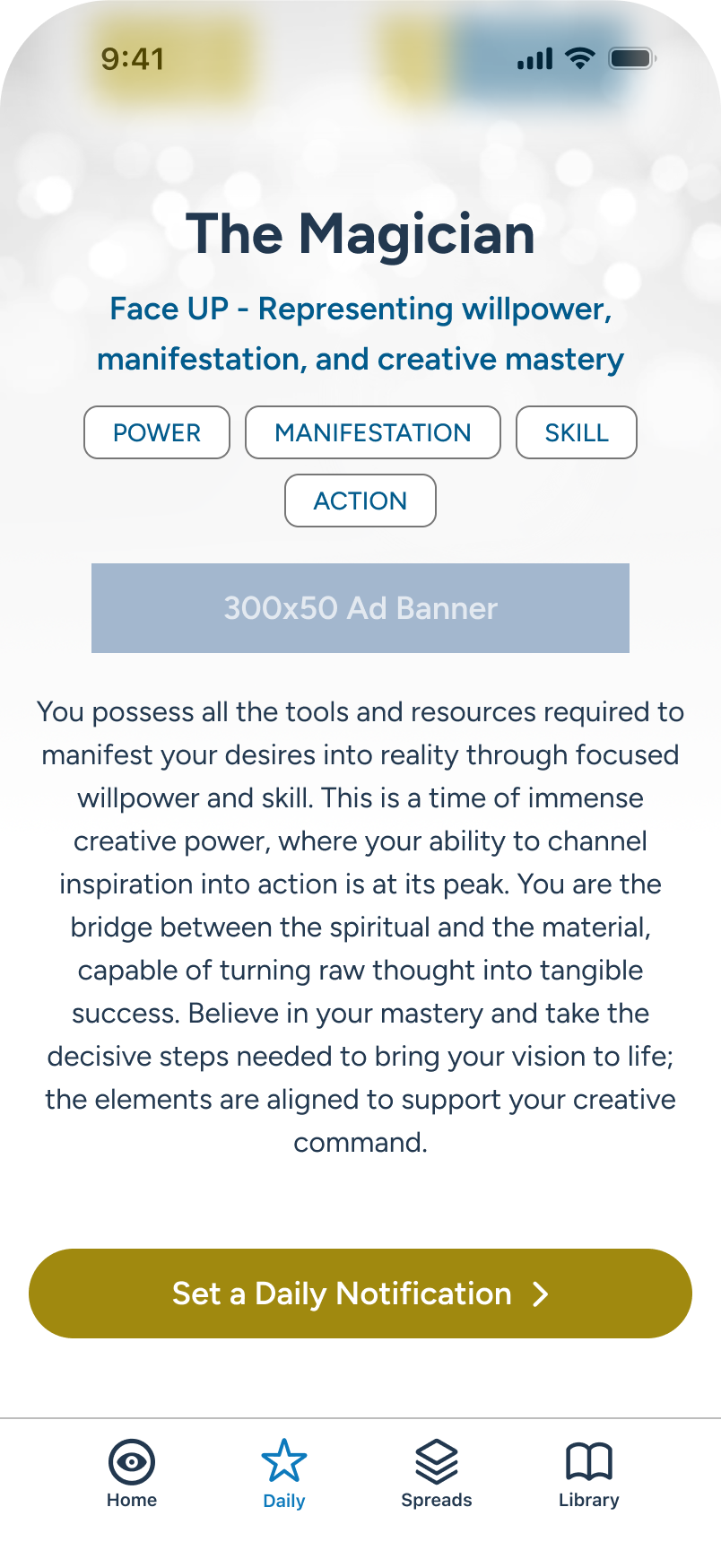
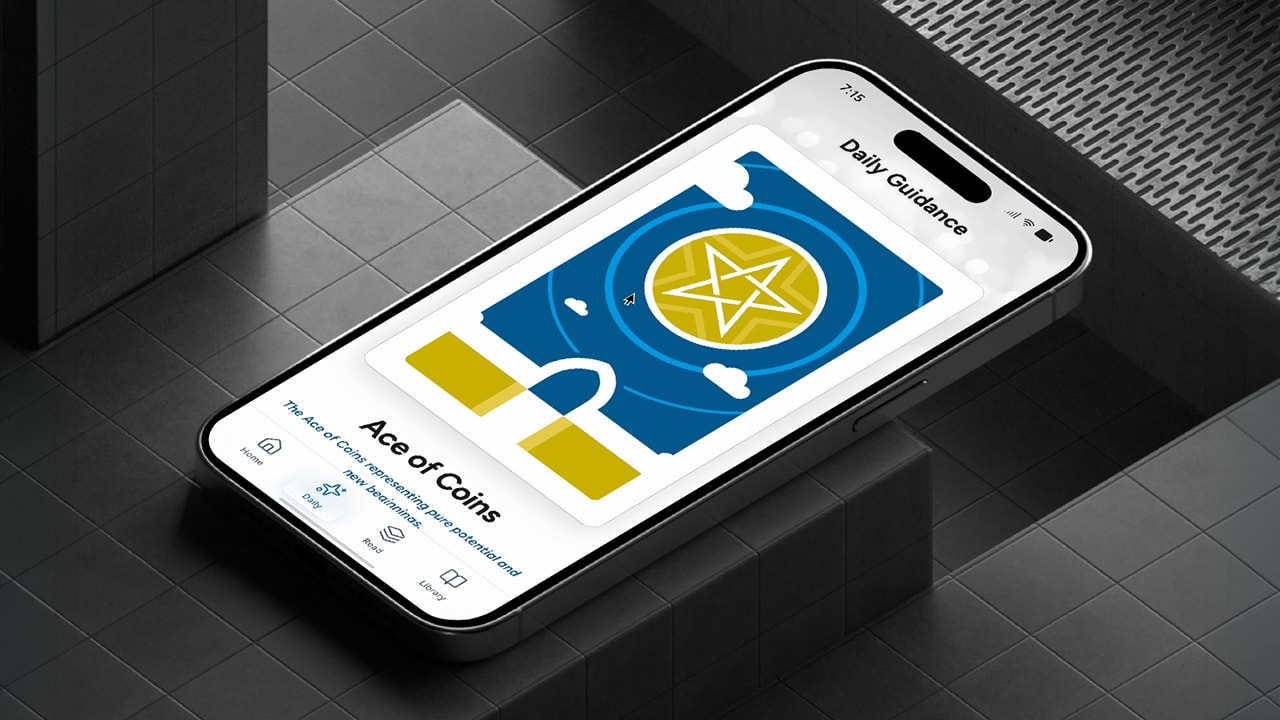
Each day, users can visit Daily Guidance for a quick, personal take on their focus — available to all tiers. As they scroll, the drawn card reveals its position, keywords, and full details. The card shown here is in the UP position, but with reversals enabled, it could just as easily appear reversed. For those who prefer an always-positive reading, reversals can be turned off. Daily notifications are also available.

Note: While not shown here, when a notification is set, it will reflect back at the bottom of the Daily Guidance, with an edit feature, in place of the current CTA.

The user explores “Daily Guidance”, either from Home or from the “Daily” tab, at bottom.

The user sees the card drawn, and can scroll down to see details.

Further details, with inline ad banner. At the end, an offer to receive daily notifications. The user investigates...

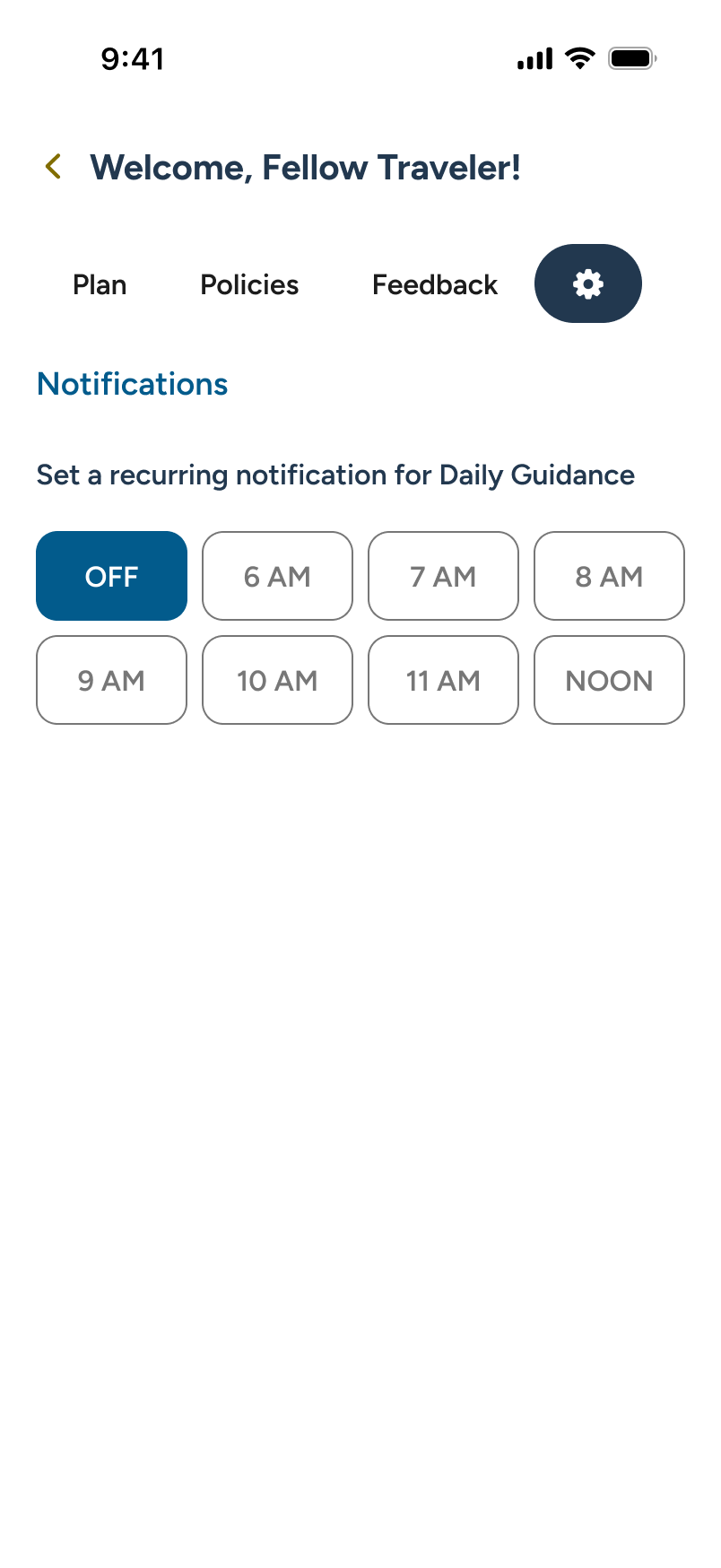
In User Hub / Settings, the user can select from a number of notification periods, and iOS will then confirm.

Multi-Card Spreads

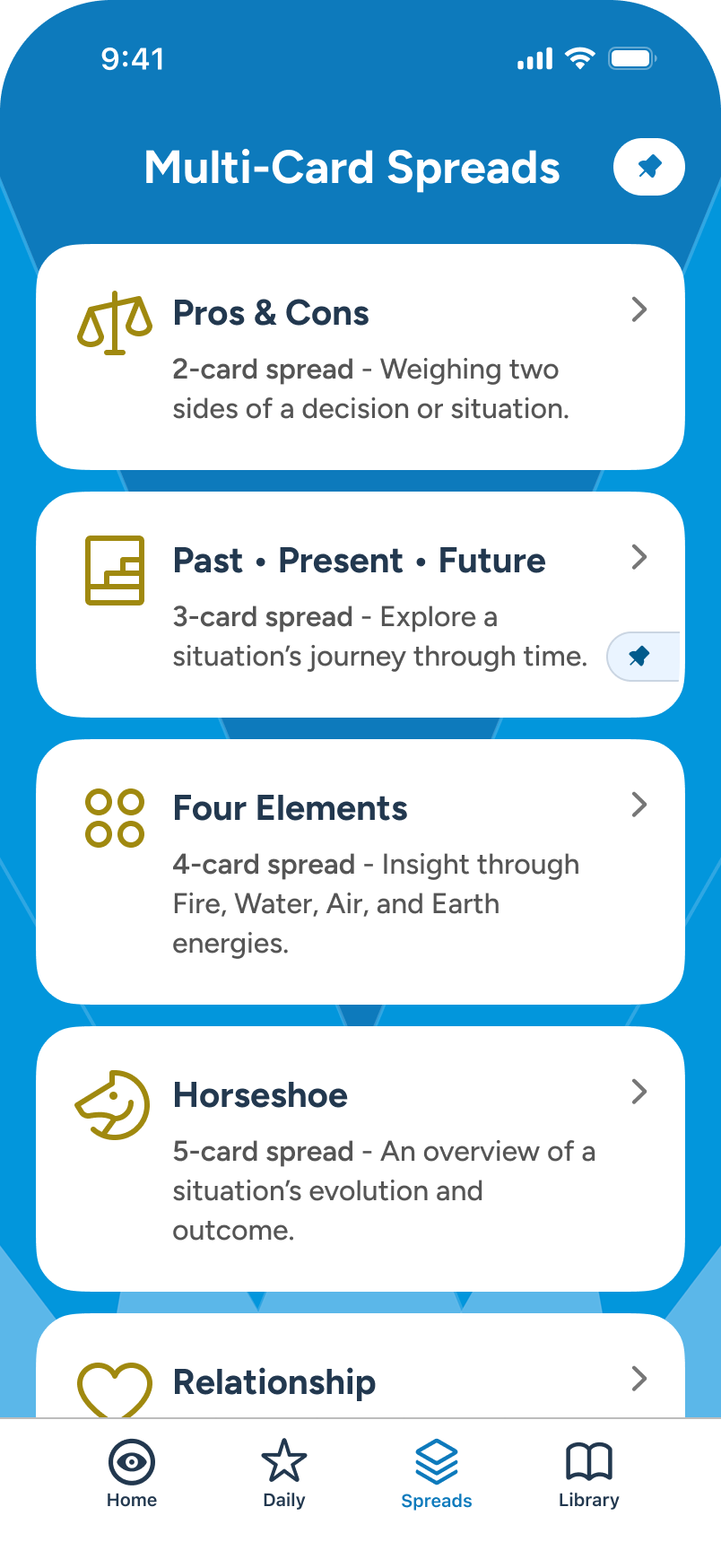
As part of the subscriber model, users have access to a large range of popular spreads with which to generate an advanced reading. All multi-card spreads feature advanced AI-generated summarizations and more. A full walk-through of a multi-card reading follows further in this review.

Note: Freemium users can browse the full spread list — all cards locked — with a direct CTA to the Plan section. A low-friction second path to conversion.

The subscribed user is exploring the "Spreads" section, either from Home card or via the Spreads tab.

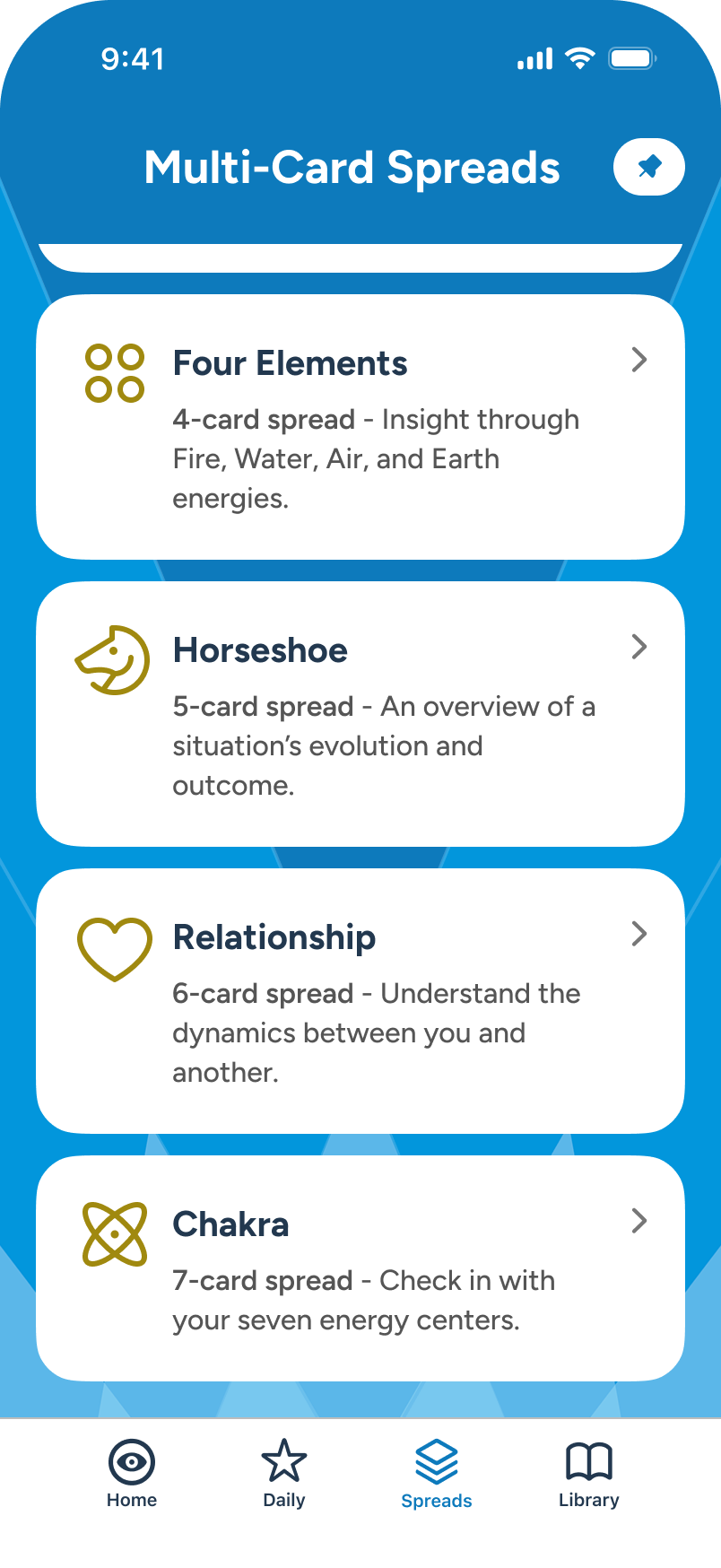
The user swipes upward, reviewing a number of popular spreads...

6 spread types are currently available.

Multi-Card Reading: Query, Card Selection, & Reading

Query + Focus

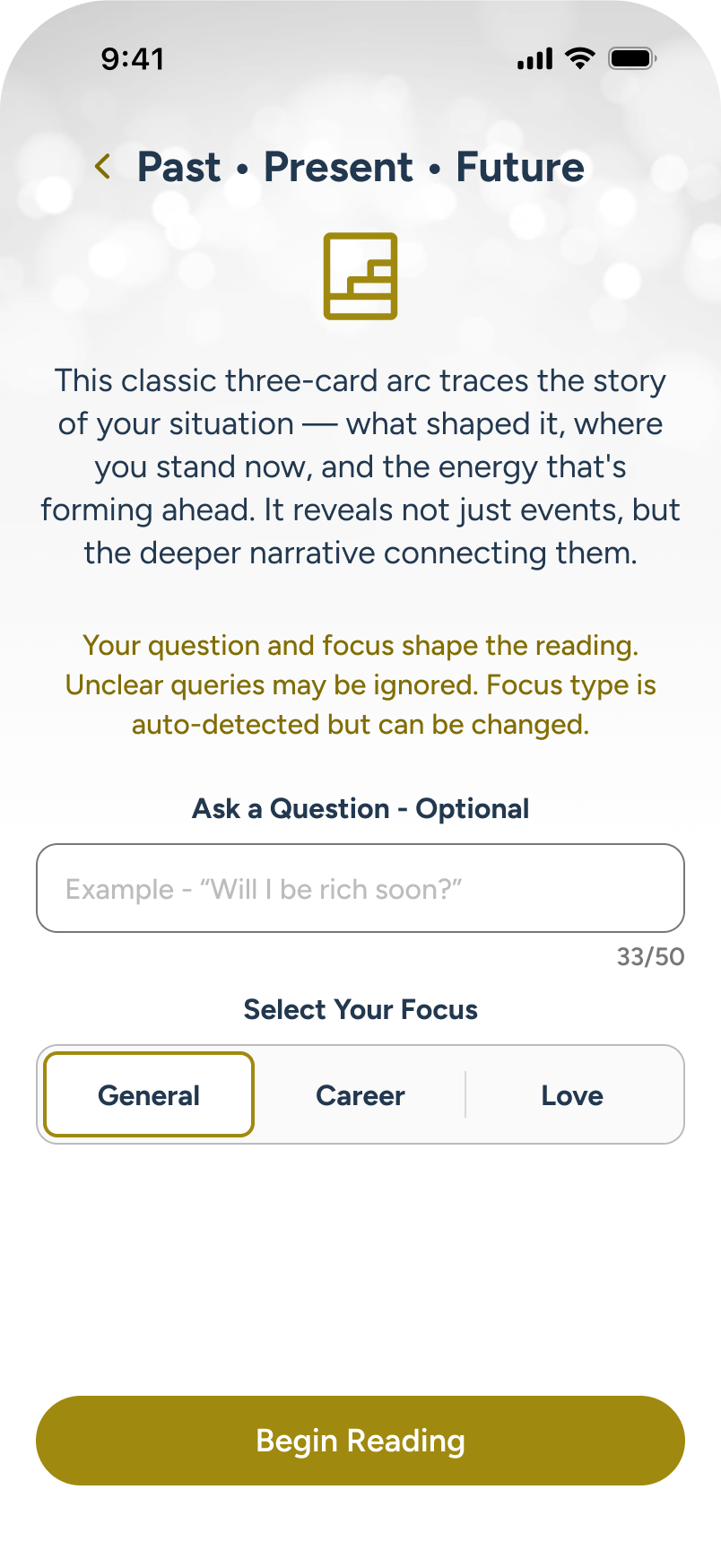
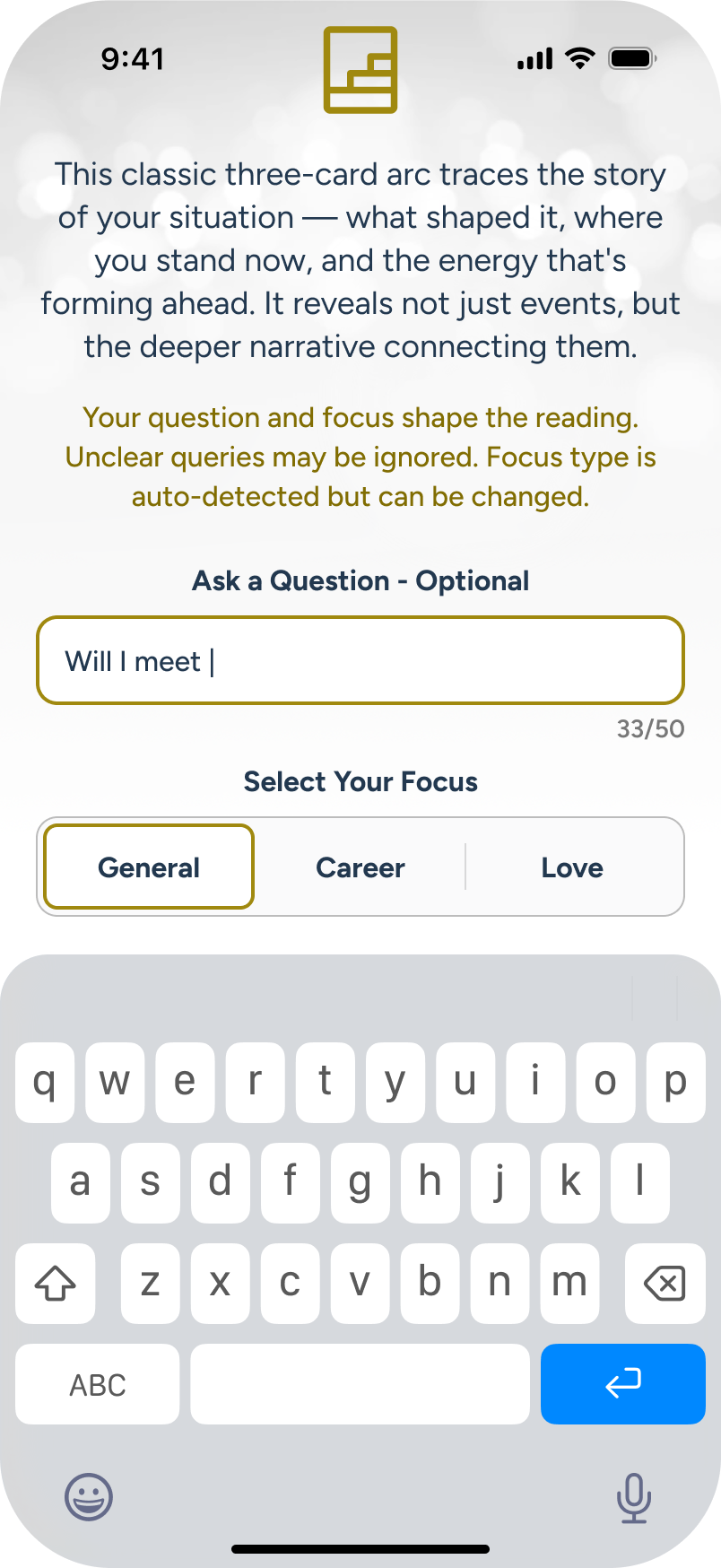
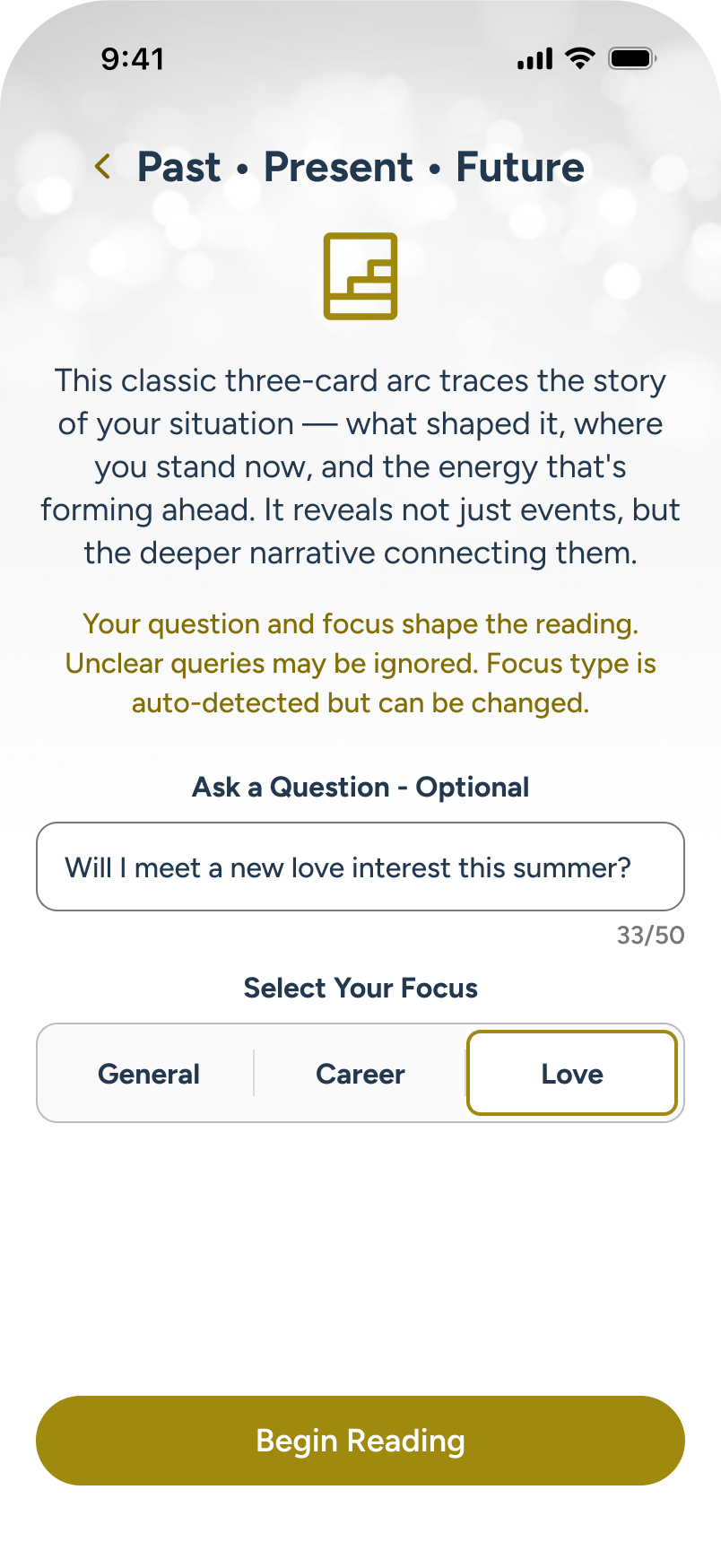
Multi-card readings are available to subscribers and accessible from the Spreads section. In this scenario, the user selects “Past • Present • Future”. Before drawing cards, the user can supply an optional query to shape the final output. When ready, the user moves to “Begin Reading” CTA and taps.

Note: While focus can be manually toggled, it's also query-responsive: certain keywords like "Love" will auto-shift it without intervention. The user always has ultimate control, and AI summarization accounts for all of it.

From Spreads, user selects “Past • Present • Future” multi-card spread.

Here, the user can add an optional query, and/or change focus for the reading. User taps query field.

User types a query about love, and commits it. In the next screen, this will auto-select the “Love” focus.

User is ready to proceed to card draw, so they tap “Begin Reading” CTA.

Cards Select

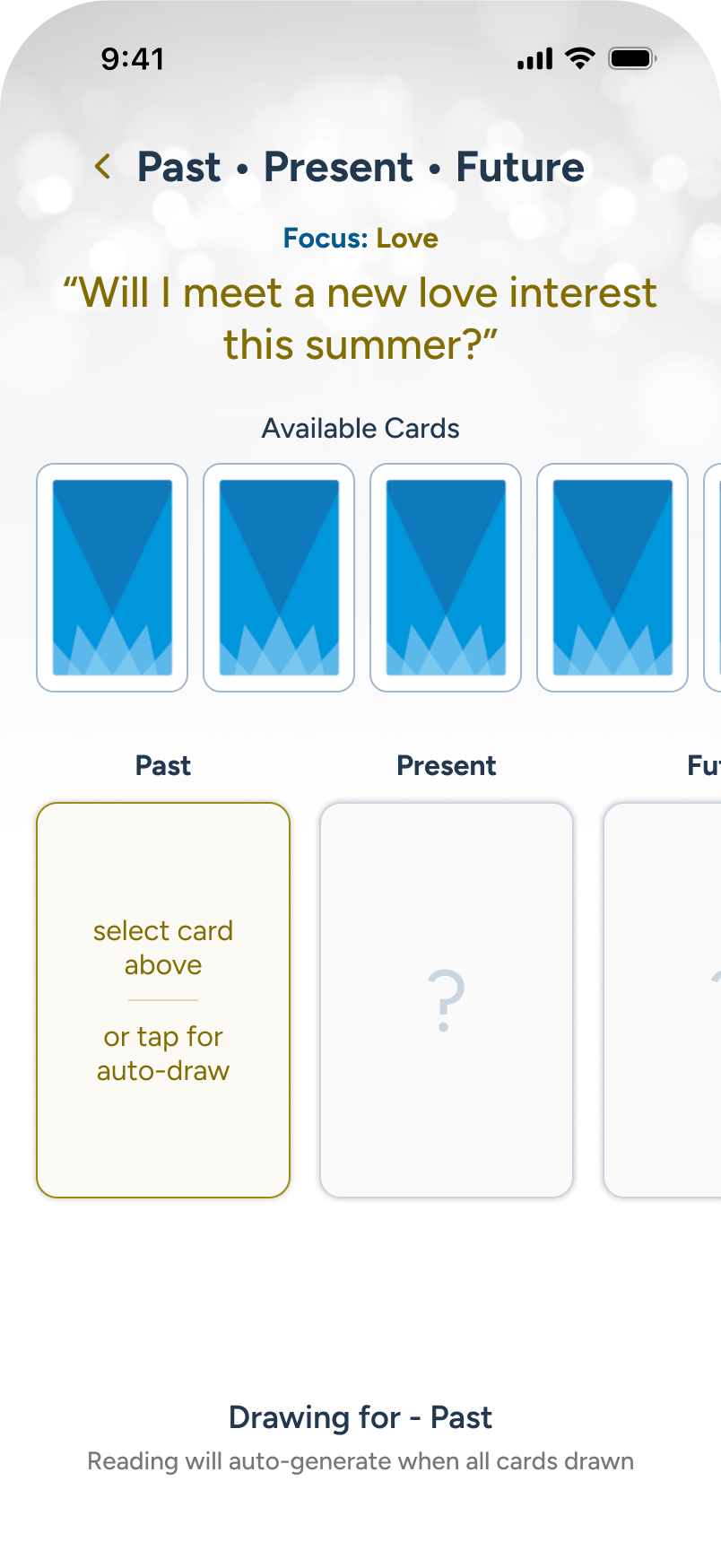
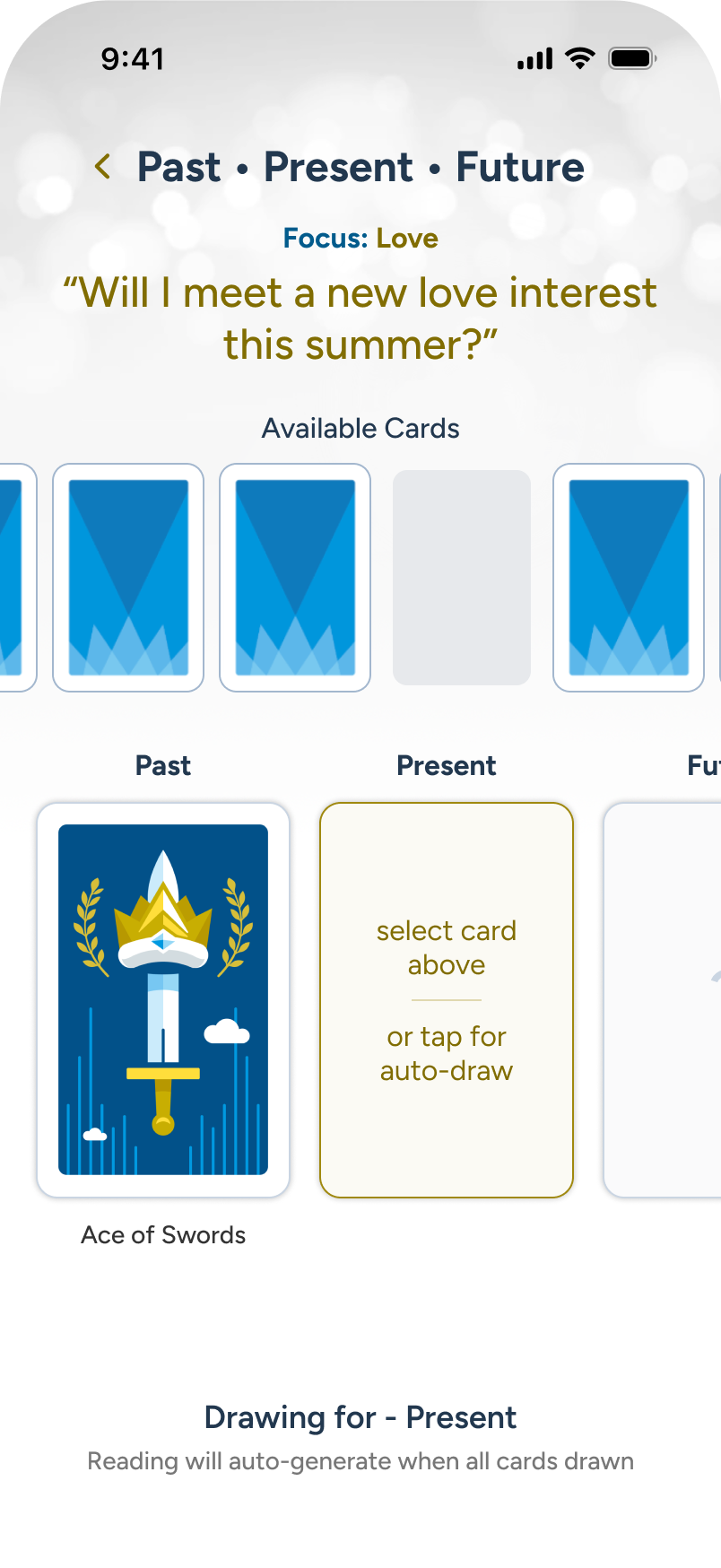
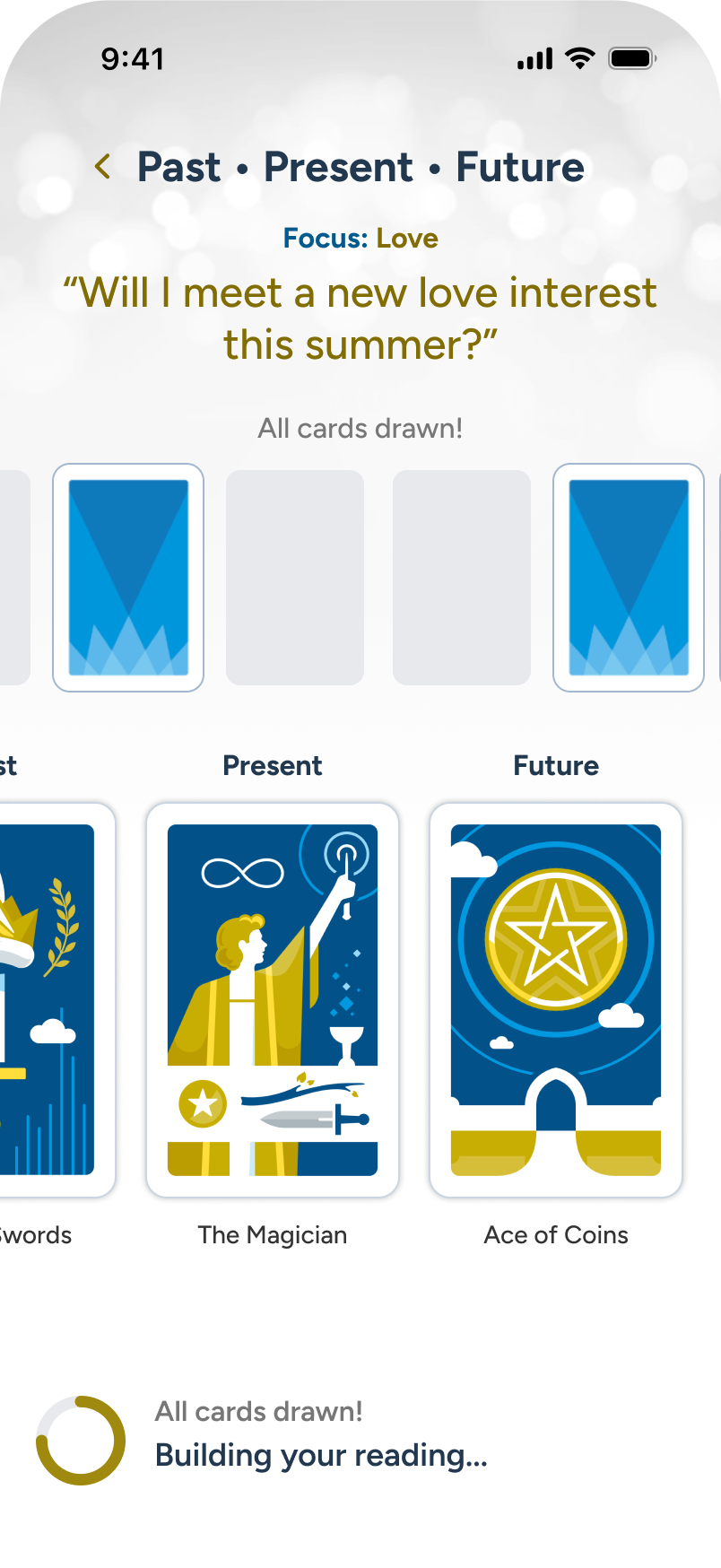
The user moves to the card selection stage, displaying reading type, focus and optional query at top. The body shows a scrollable carousel of available cards, with draw positions below. Guidance text along the bottom guides users through card selection.

Note: A unique feature: users can manually draw cards or tap the in-focus position to let AI draw them.

The query and focus are brought forward to the card reading area, and the user begins to select 3 cards.

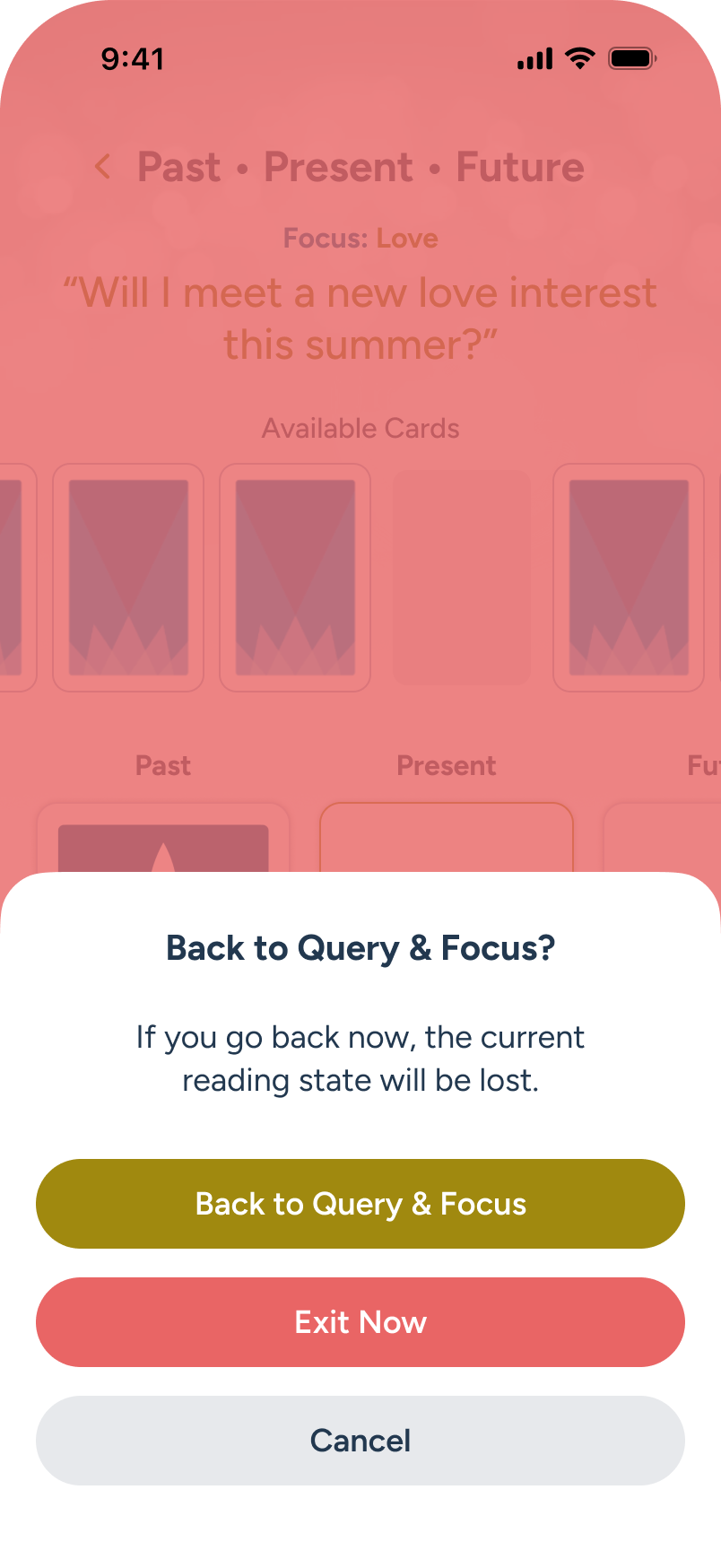
As the cards are drawn, user considers changing the query, so they tap the back arrow at top left.

A modal warns that progress will be lost if going back; the user chooses to continue.

Once all cards are drawn, the AI begins building the summary, shown at the bottom.

Summarized Reading

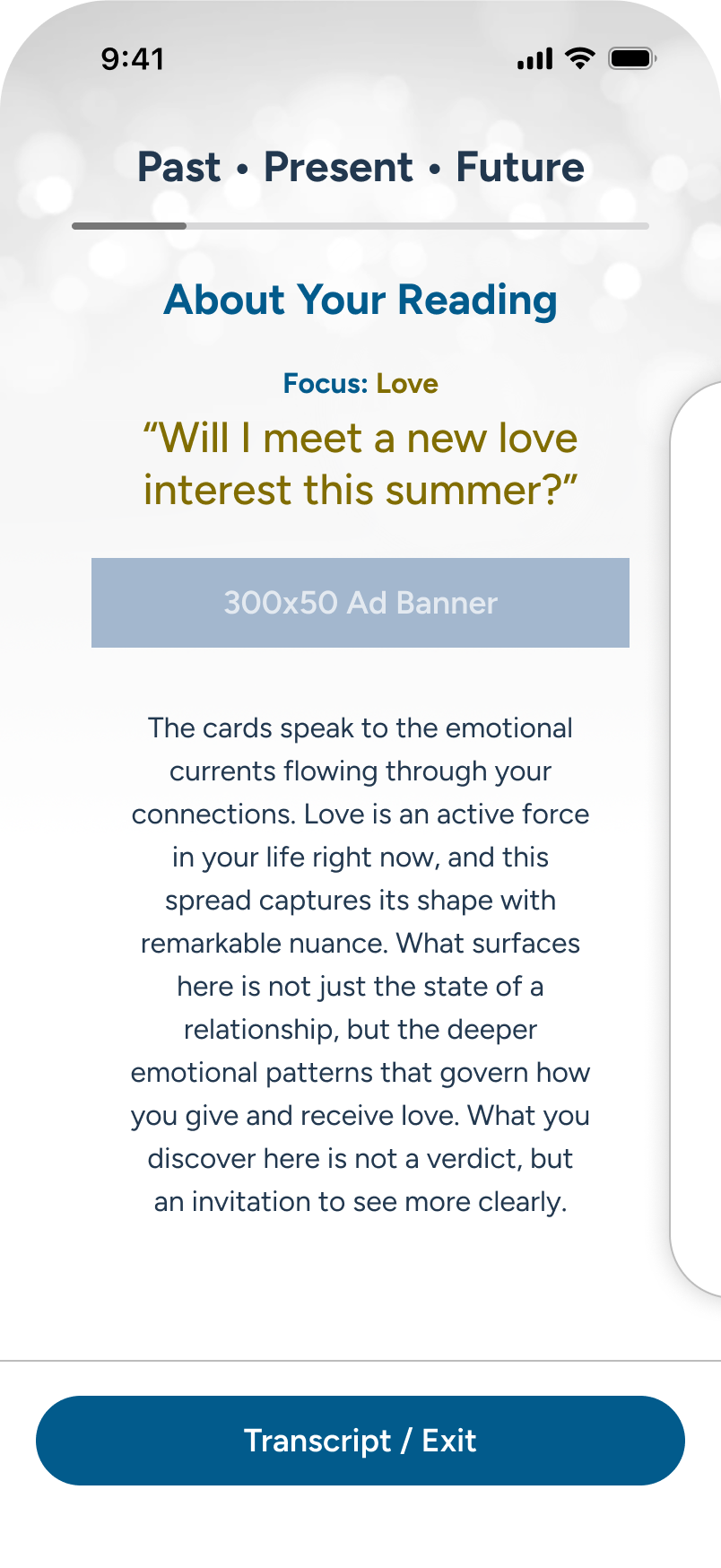
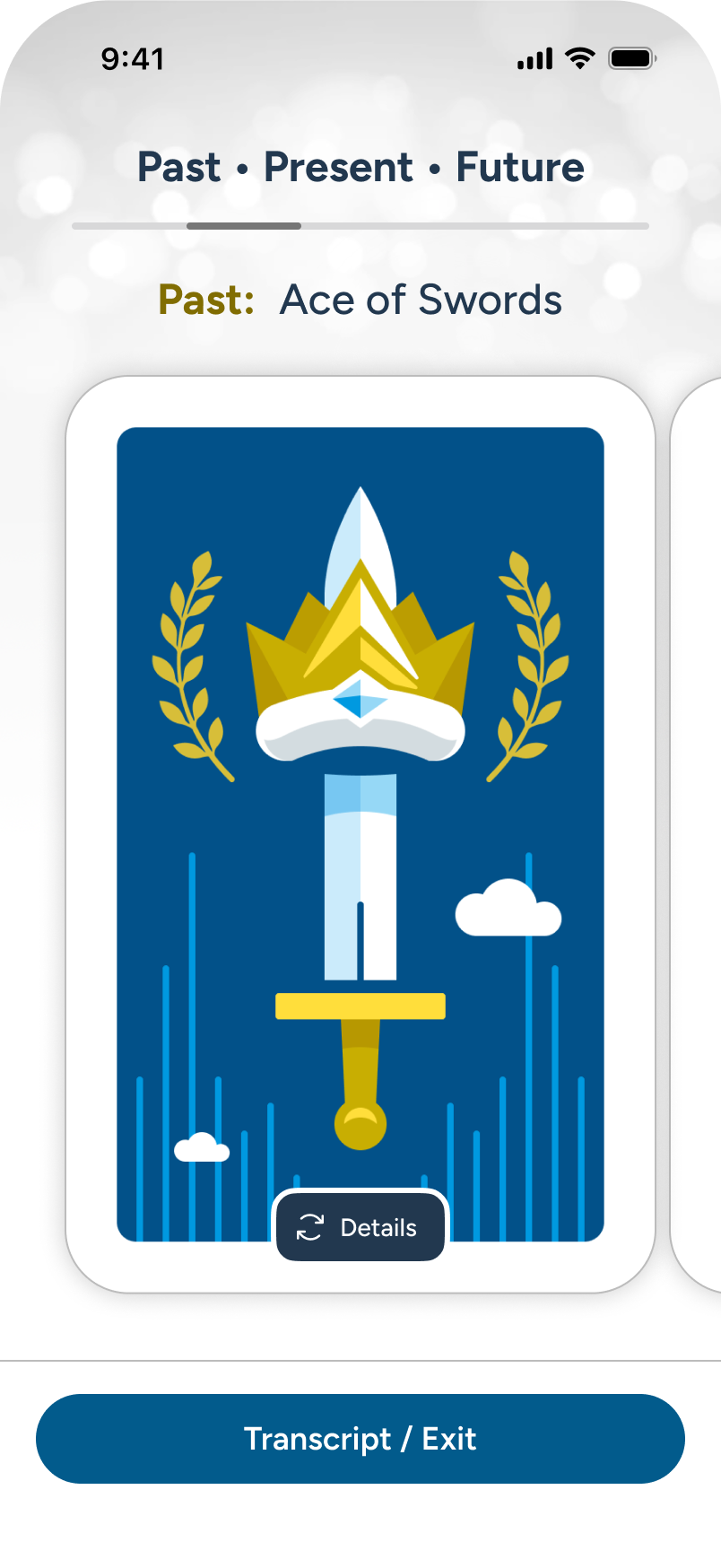
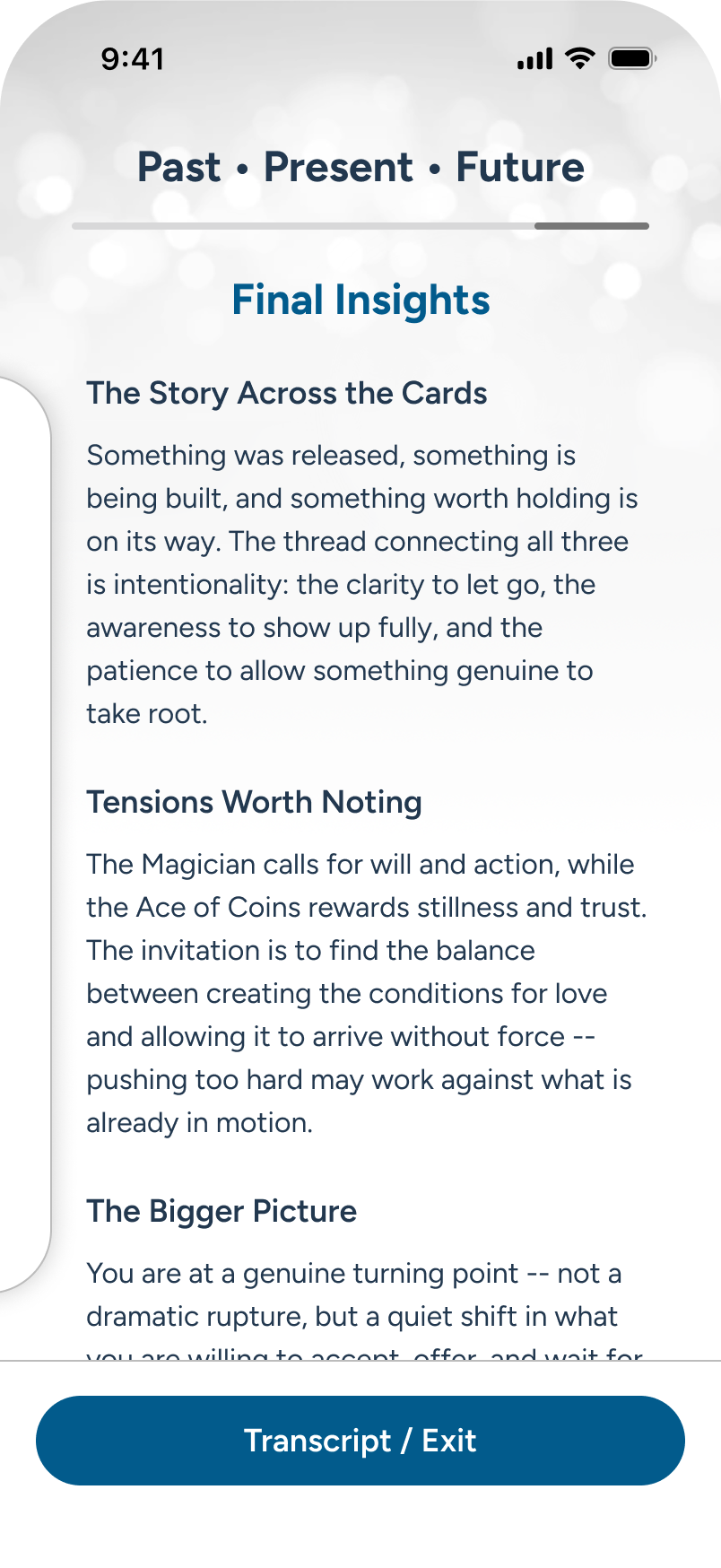
The AI summarized multi-card reading is now ready for review, offering an overview, large, flippable cards for each position, and closing remarks at the end. The details for each card is AI-tailored to the overall reading, not just boilerplate copy from the Library. Once done, the user can either exit to Home directly or download a transcript and exit, as discussed in the next panel flow.

Note: Basic users will be able to draw up to one card in any spread, after which they will receive a path to upgrade. No AI summary final readings without a subscription.

The multi-card reading is under review. Story progression is horizontal, like the draw. User swipes.

From 2 to 12-card spreads, carousel progression tracks under spread title. The user taps “Details” to flip card.

The user reads the customized text based on the card, its position, and other supplied factors. User swipes.

Jumping to the end, the user receives a positive send-off. They now proceed to tap “Transcript/Exit” CTA.

Multi-Card Reading: Transcript + Exit

Initial Screens

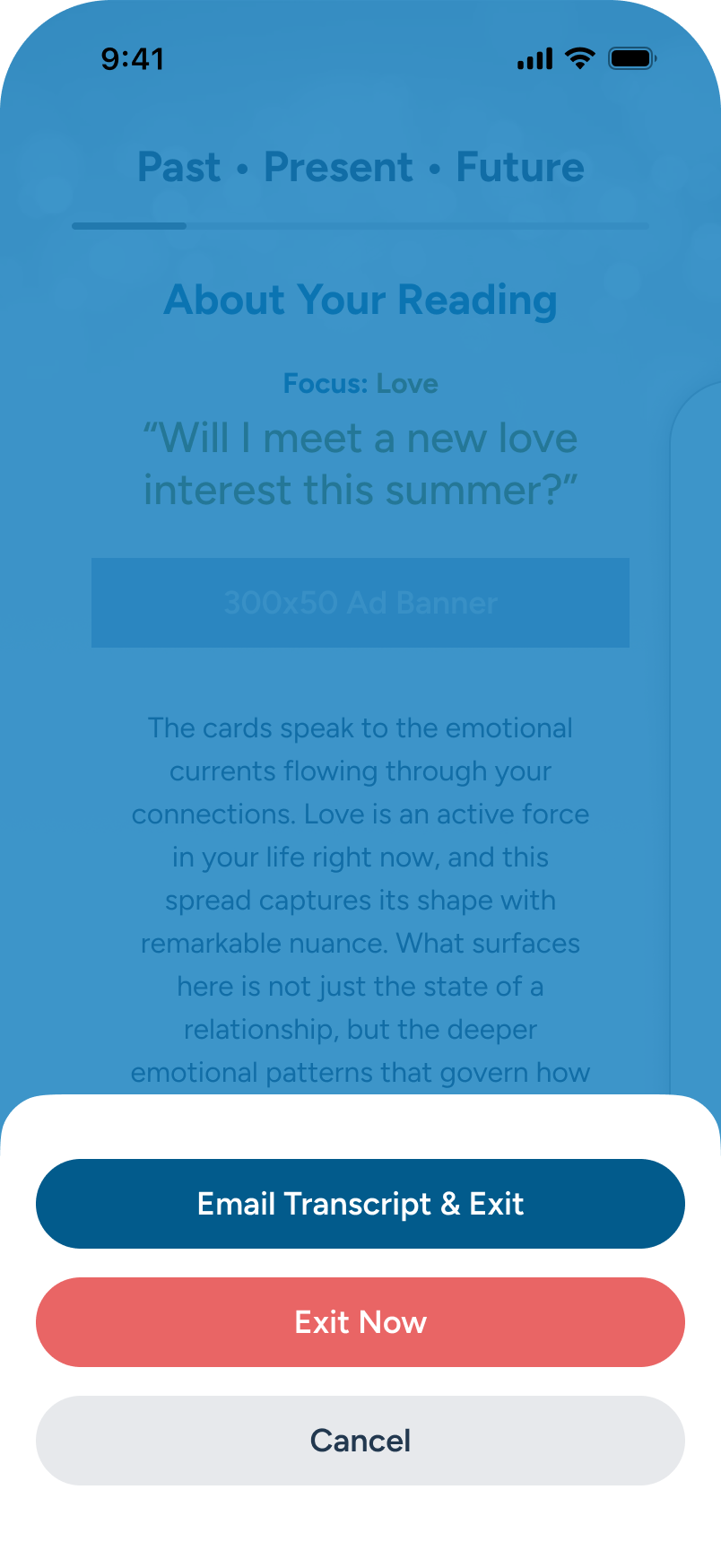
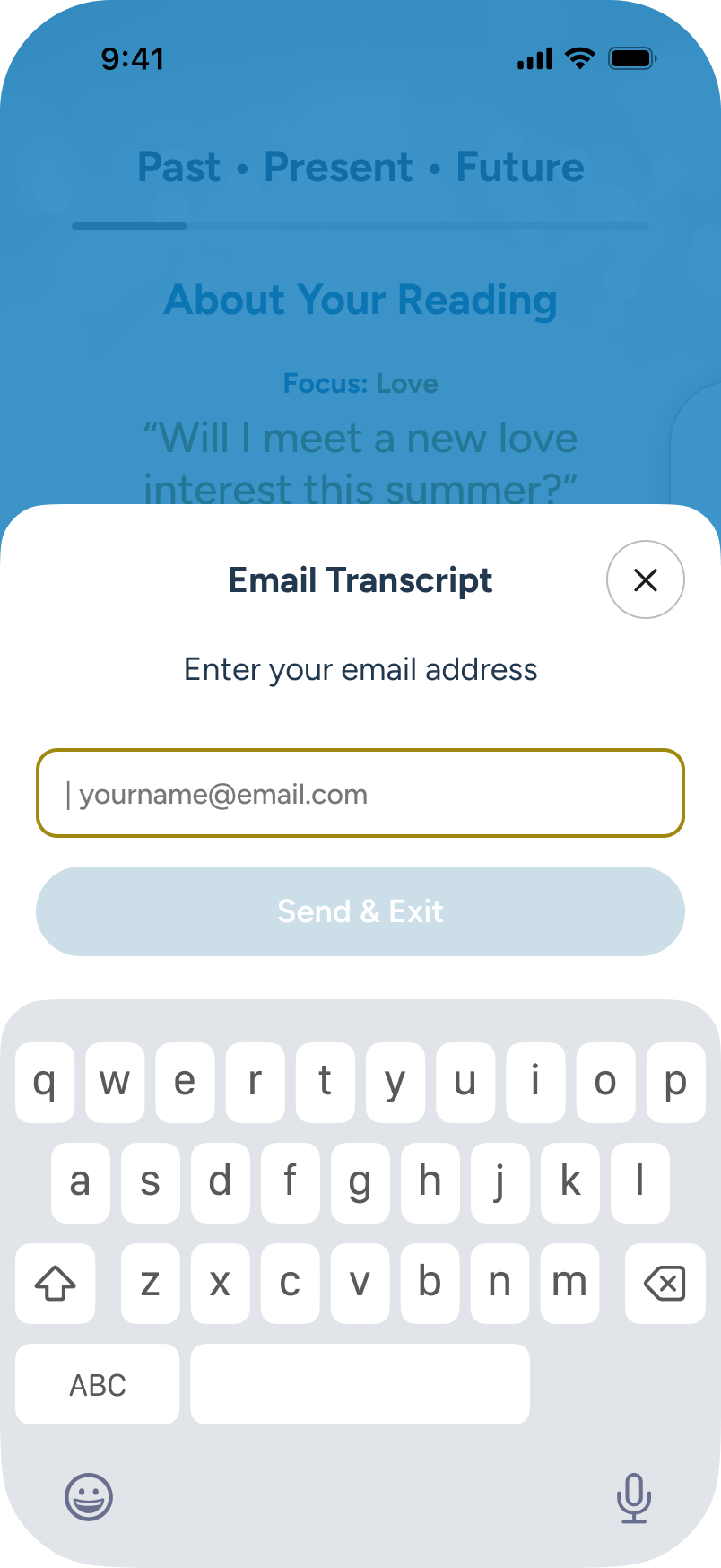
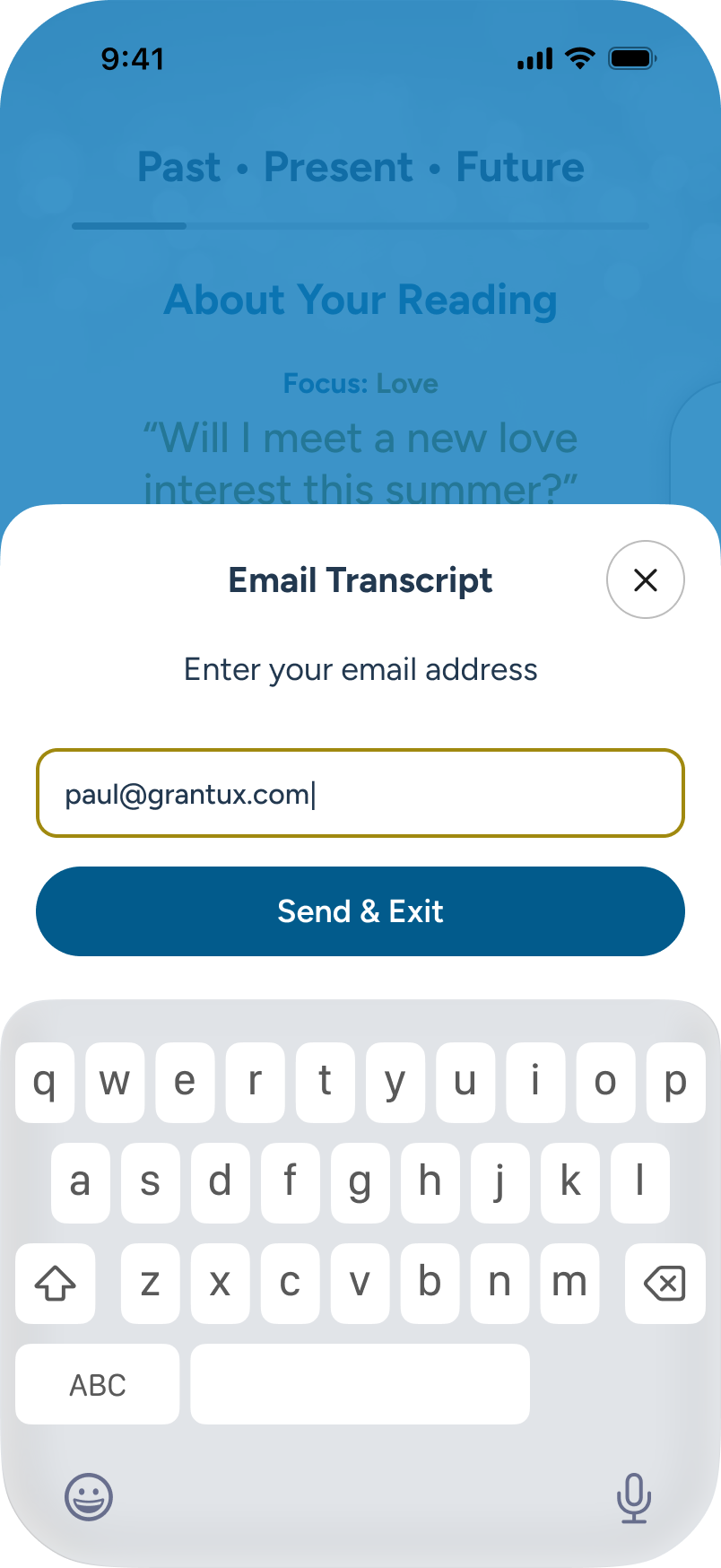
The user has chosen to exit their reading from the sticky footer’s “Transcript / Exit” CTA (shown in previous screens). In this example, an overlay of options appears, and the user chooses to receive a transcript upon exiting. As they fill out the email, the system confirms syntax and then allows them to proceed through to the “Send & Exit” CTA.

Note: When invoking the exit scenario, the reading in the background automatically returns to the top of the page, providing reading context during transcript screens.

The user selects “Email Transcript & Exit” CTA option.

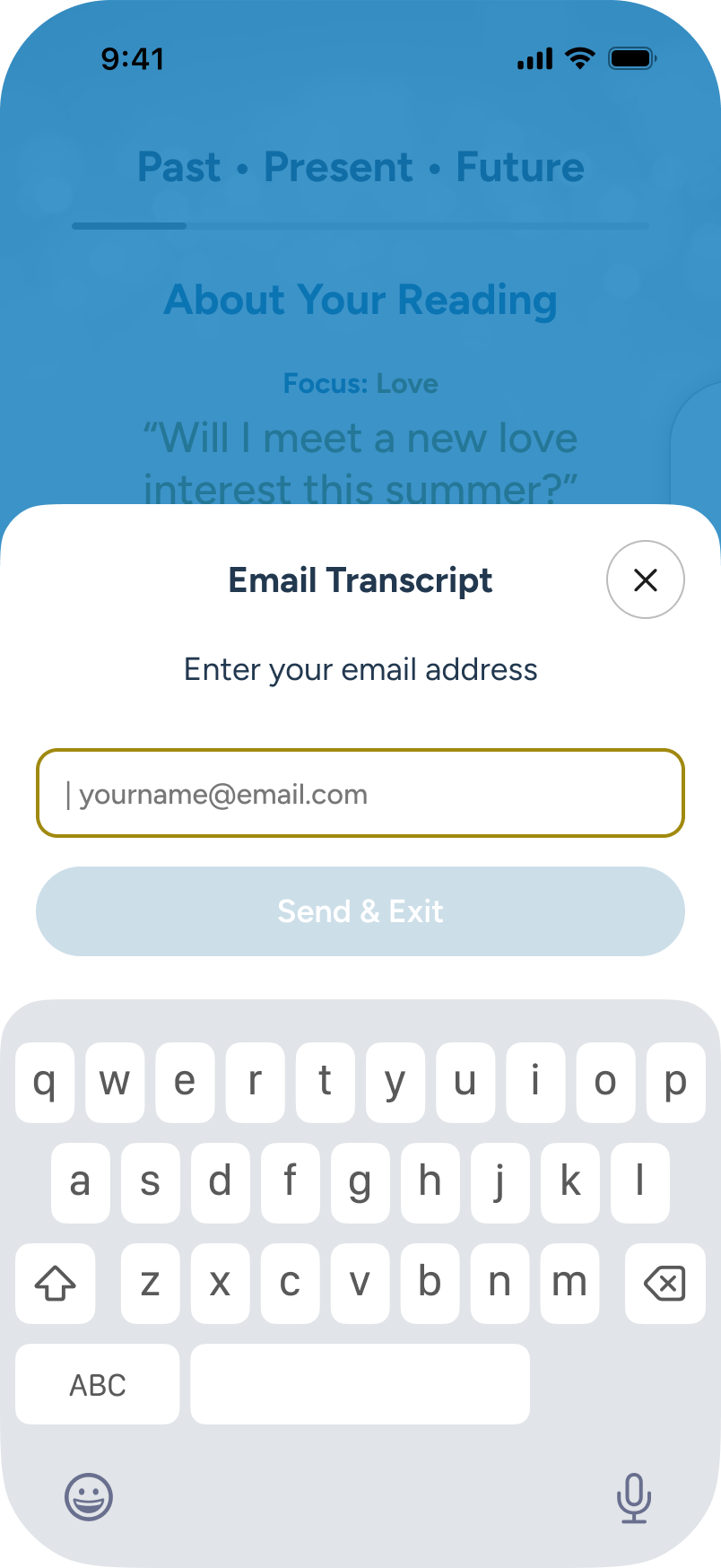
The email form appears with the field in focus. The user begins to type.

Email syntax is correct. The "Send & Exit" CTA is now active. The user presses.

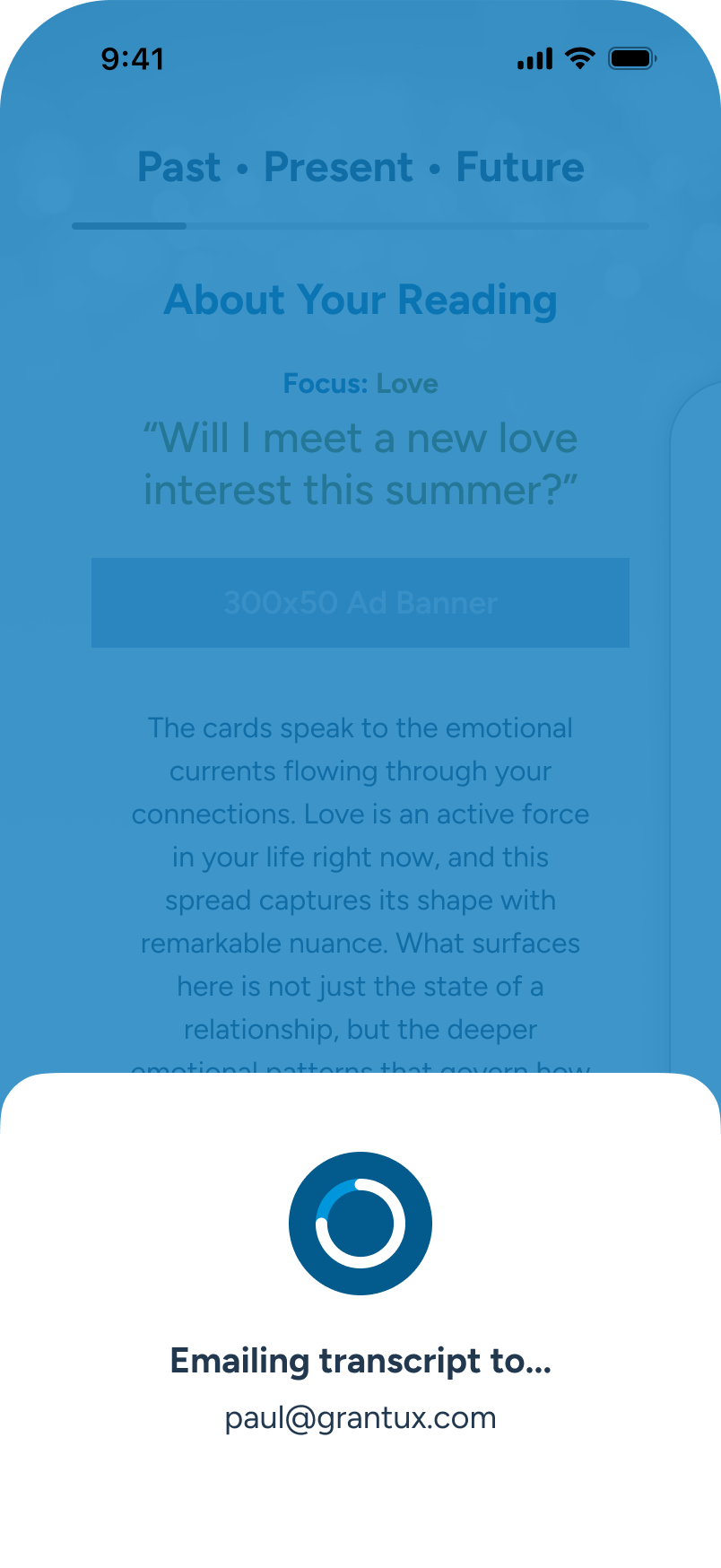
The transcript is sending...

Success/ Fail Outcome

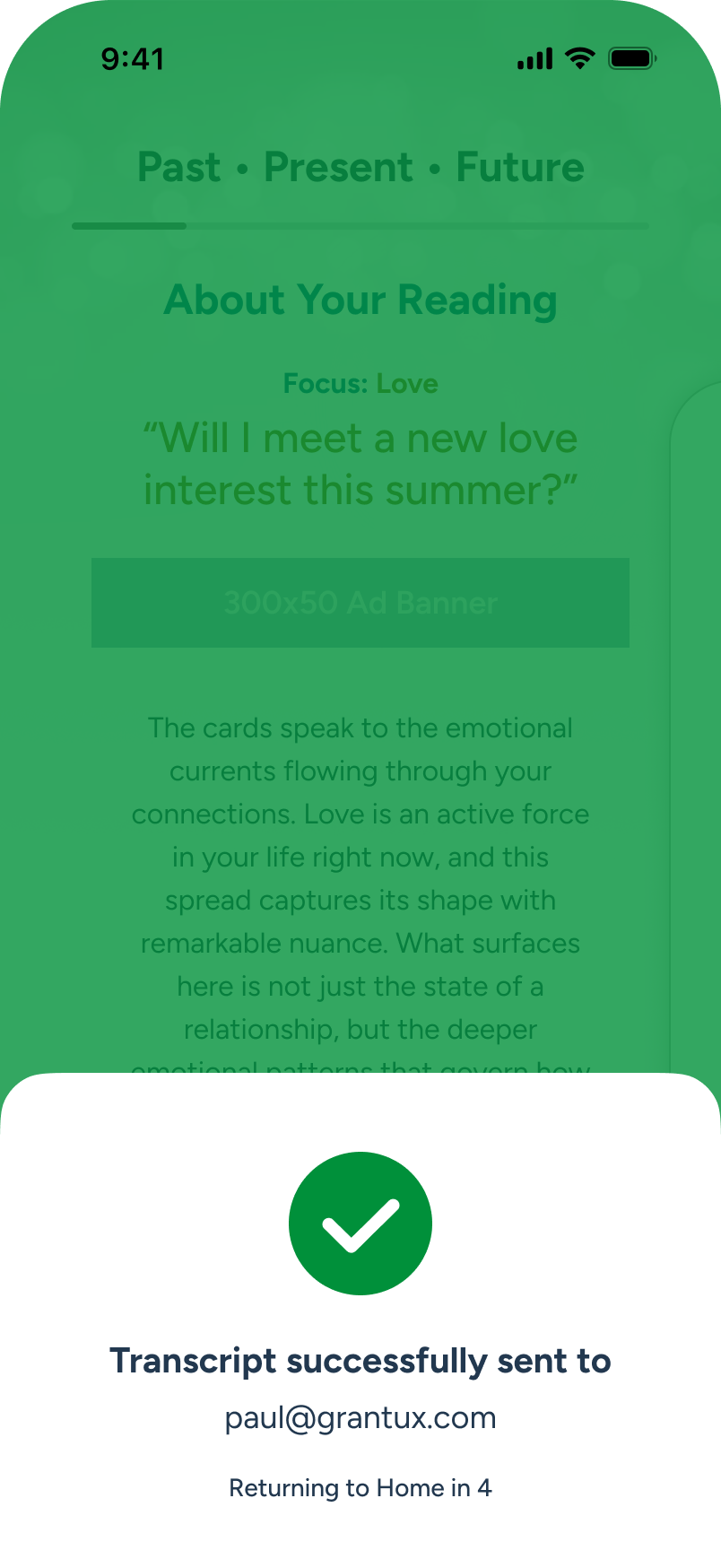
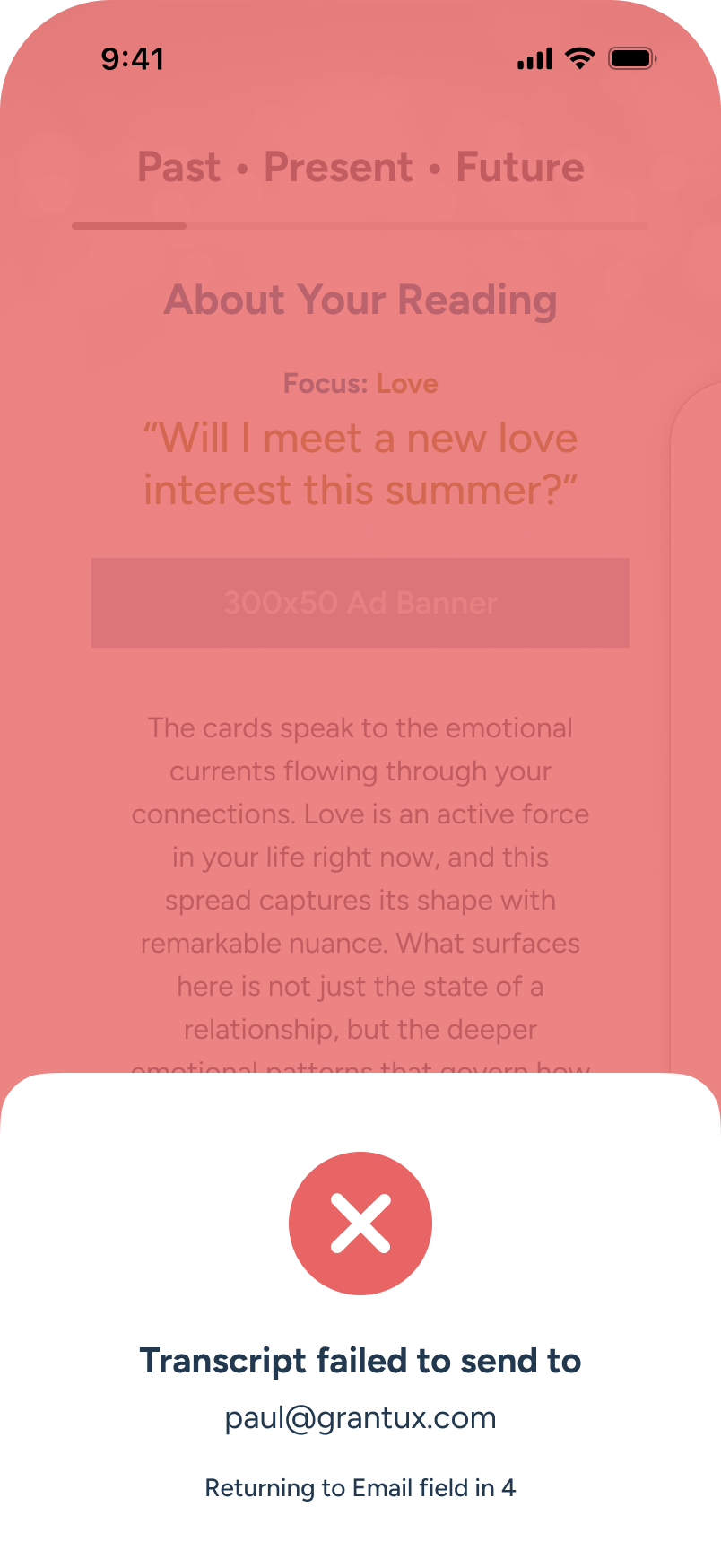
If the address is correct and there are no errors, a success message shows, and the user is returned to the Home page. Should an error occur beyond basic syntax validation, a fail message returns the user to the email form to retry.

Transcript sent successfully. User will return to Home in (TBD) sec.

The user returns to Home.

Transcript failed. User returning to email input in (TBD) sec.

The email form appears again with the field in focus. If user decides to give up, they can close using the “X” at top.

Multi-Card Reading: Loading + Error Handling

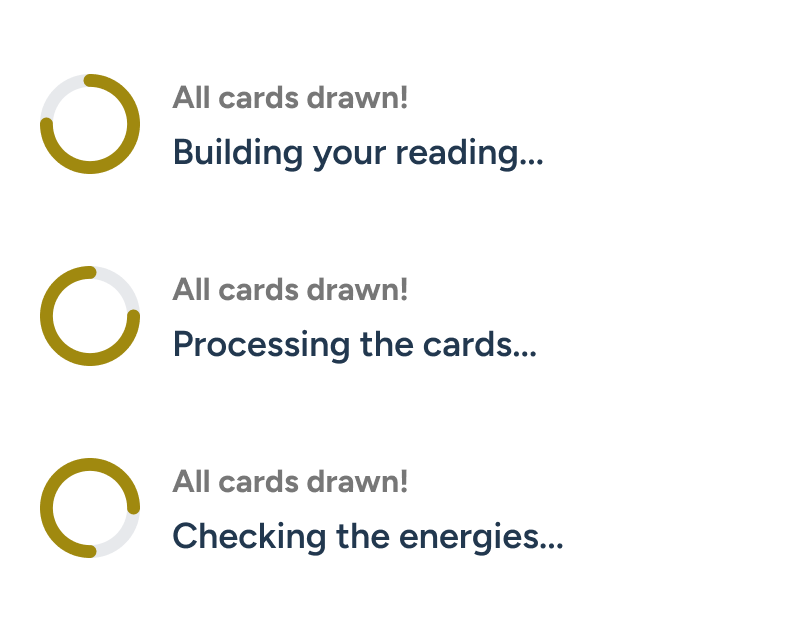
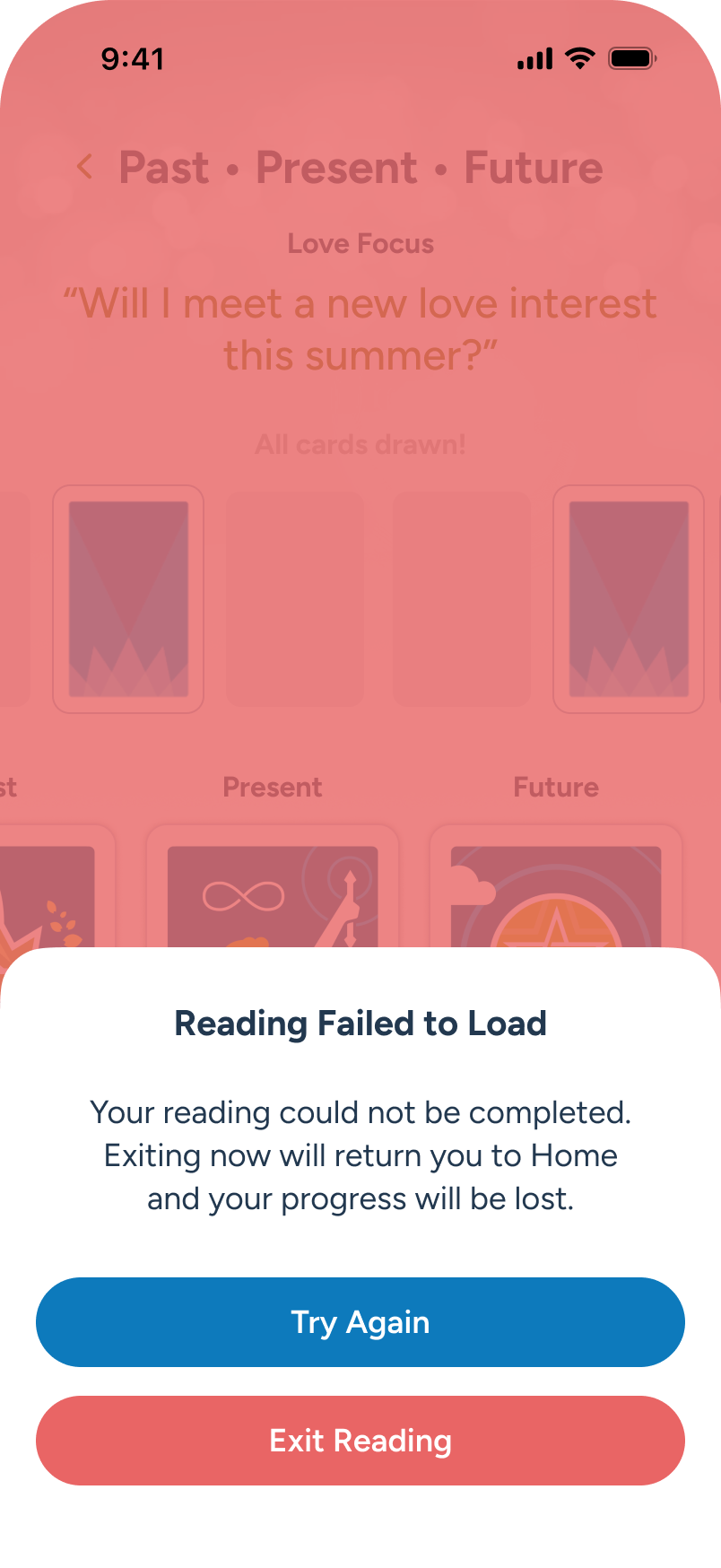
While most multi-card AI summarization completes in seconds, I added a loader with progressive messaging to build anticipation. Progressive messaging also masks retry attempts in the background. If all retries fail, a modal prompts the user to retry or return to Home.

All cards are drawn, so the system automatically prepares to present the final reading.

Normal process messaging

Attempt 1 fails silently: system retries.
Attempt 2 fails silently: system retries.

Attempt 3 fails silently: system fails.

A popup appears. The multi-card reading failed to load. The user chooses to retry or exit to Home.

Spreads: Pinning a new favorite to Home

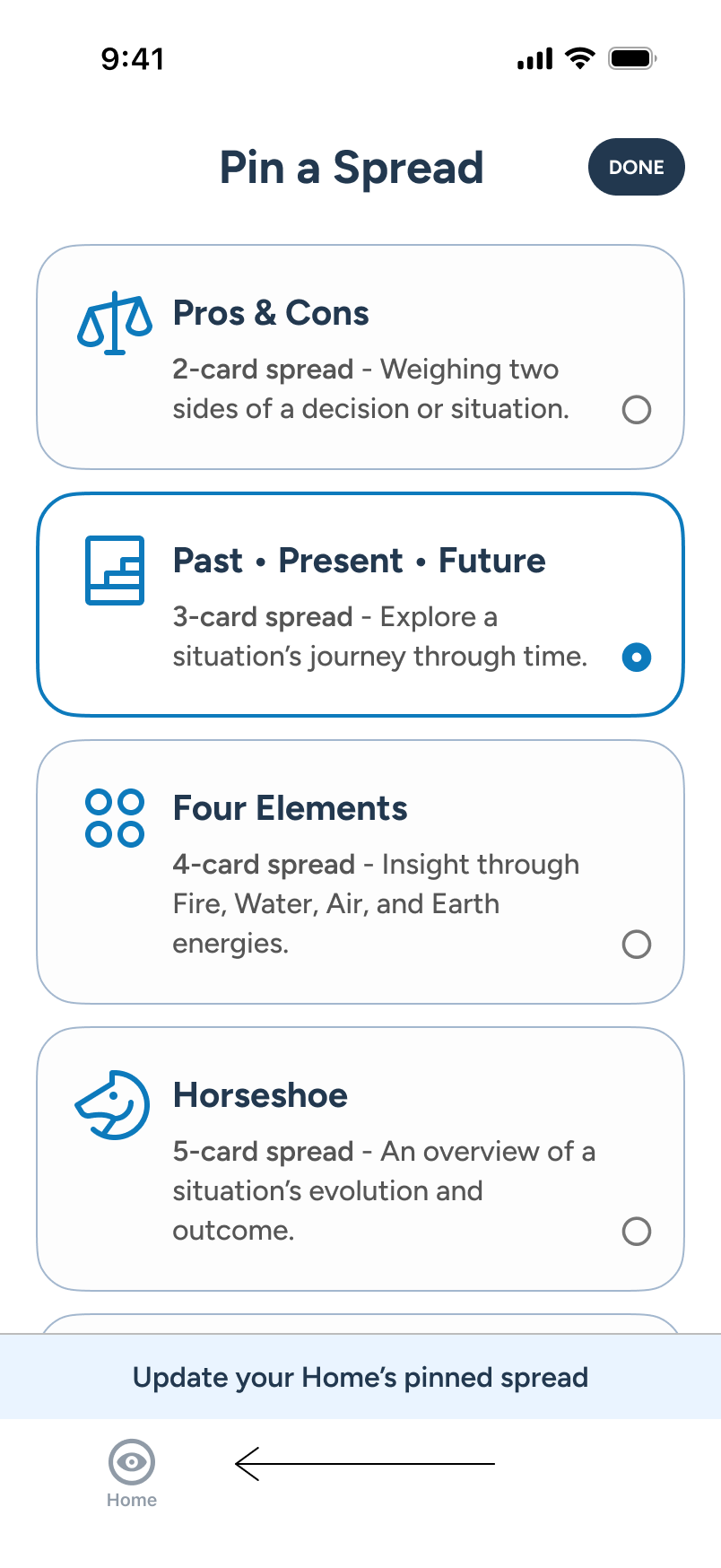
For subscribers, there’s a desire to have their favorite spread available the second they launch the app, without needing to dig through the Spreads menu. By default, we pre-pin the popular "Past - Present - Future" 3-card spread to the Home screen. As users explore multi-card spreads, they can easily swap in a new favorite. This selection can be updated directly within the Spreads area, as shown here.

The user wishes to change the pre-pinned spread, so they move to Spreads section to review options.

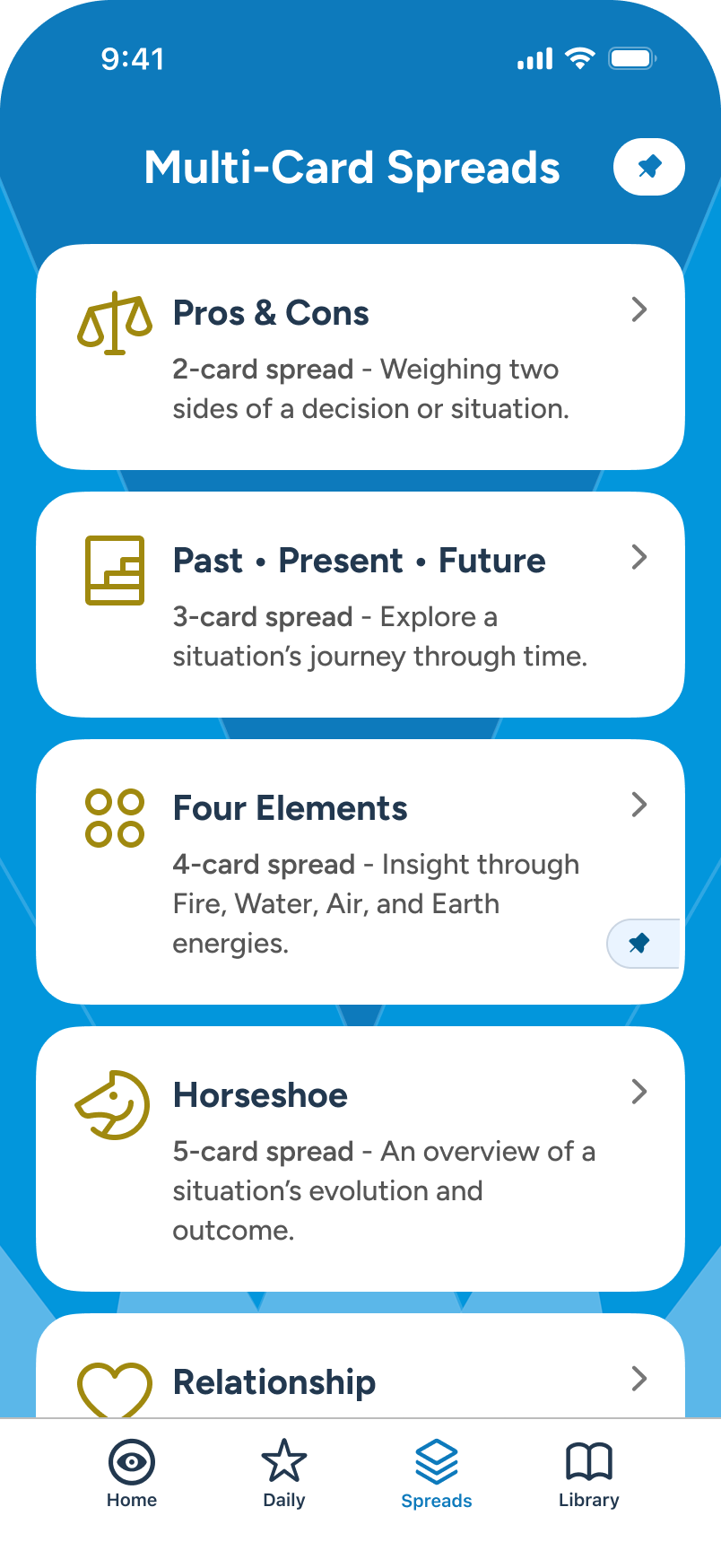
Under Spreads, the user sees the pinned selection and taps the pin edit button, top right, to change.

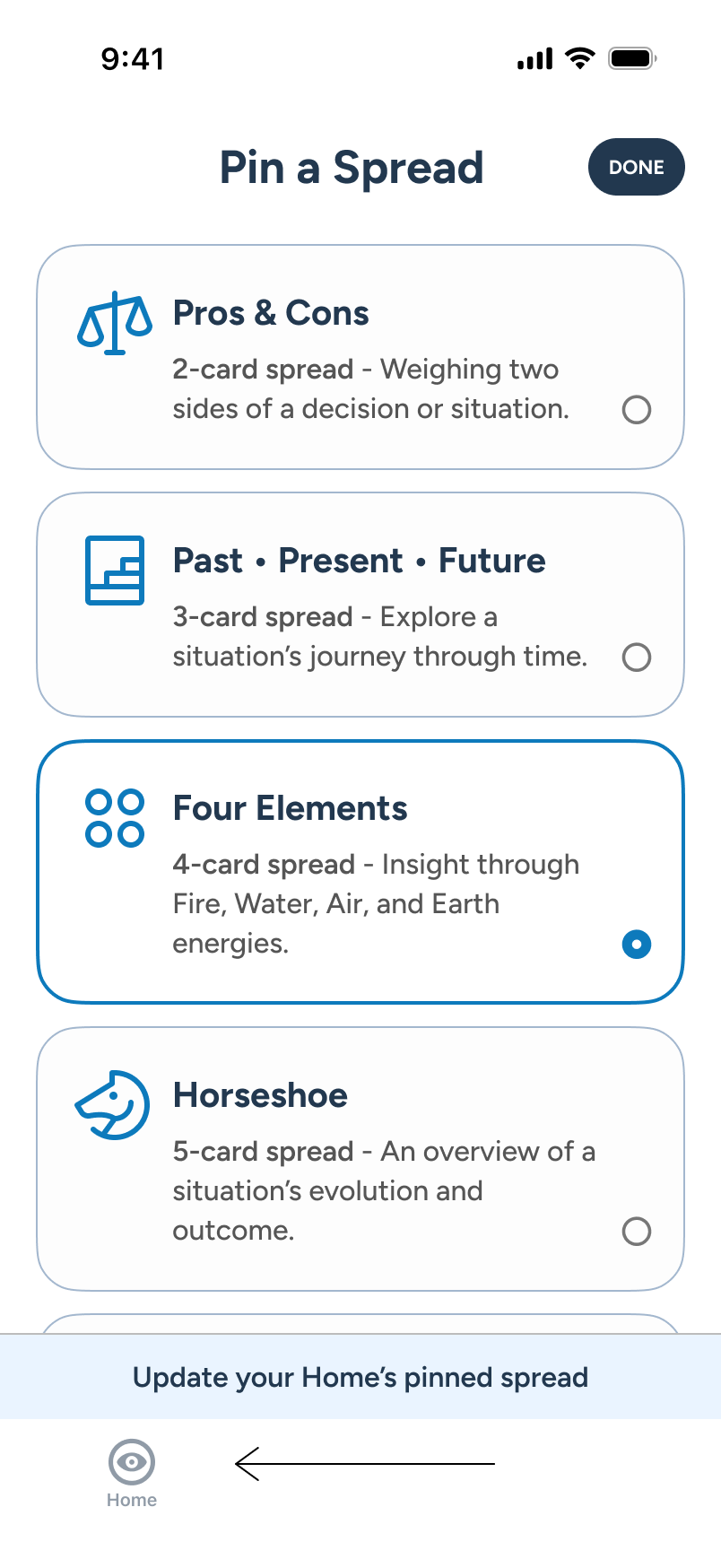
Spreads transforms into a radioed list, with guidance at bottom. User taps “Four Elements” card.

With “Four Elements” selected, the user taps “DONE” CTA at top right to commit the pin change.

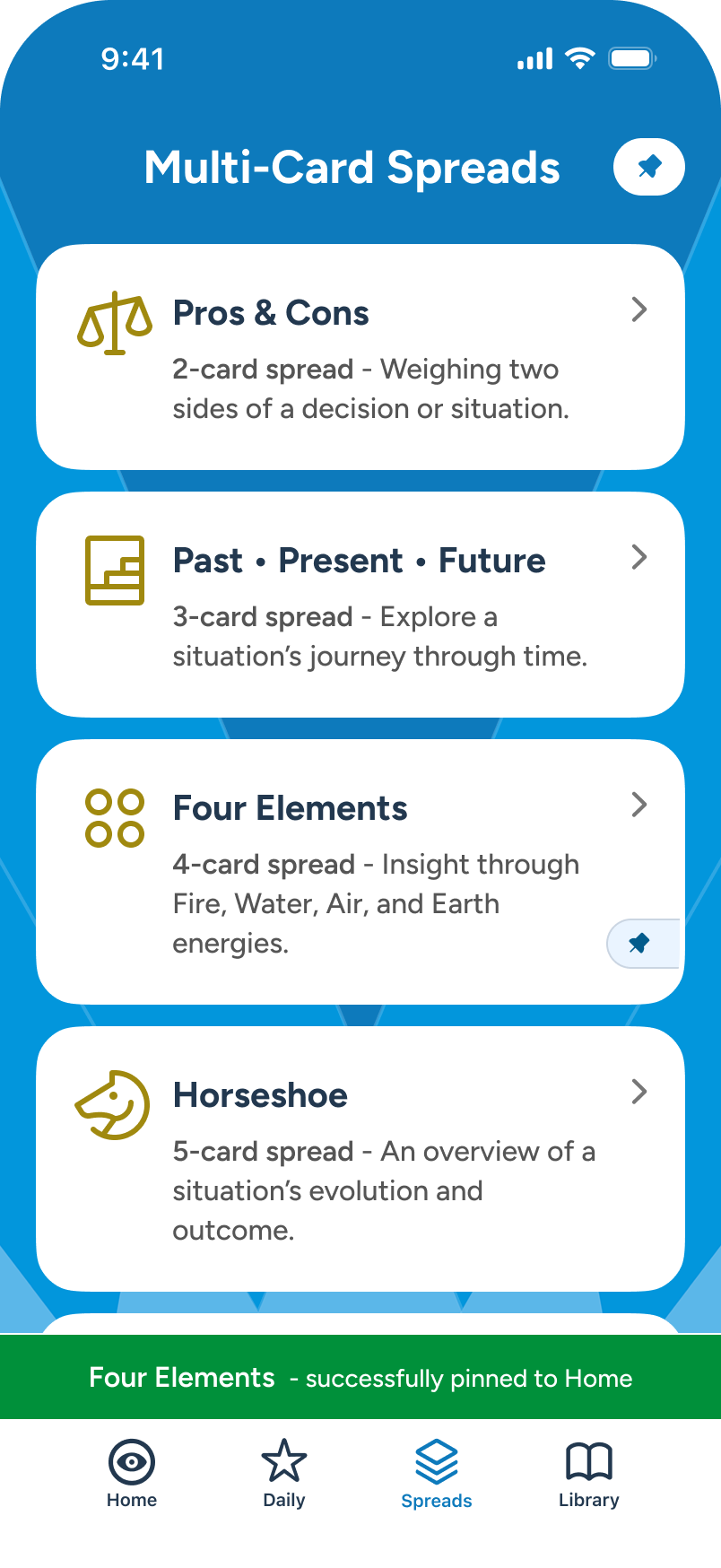
The user returns to standard view. A toast confirms the Home change. Pin marker on the new selection updated.

The toast auto-clears after a few seconds. Satisfied, the user taps Home tab to review change.

Returning Home, the user confirms that “Four Elements” is indeed pinned in place of the previous spread option.

Library: Search and Review

Initial Screens

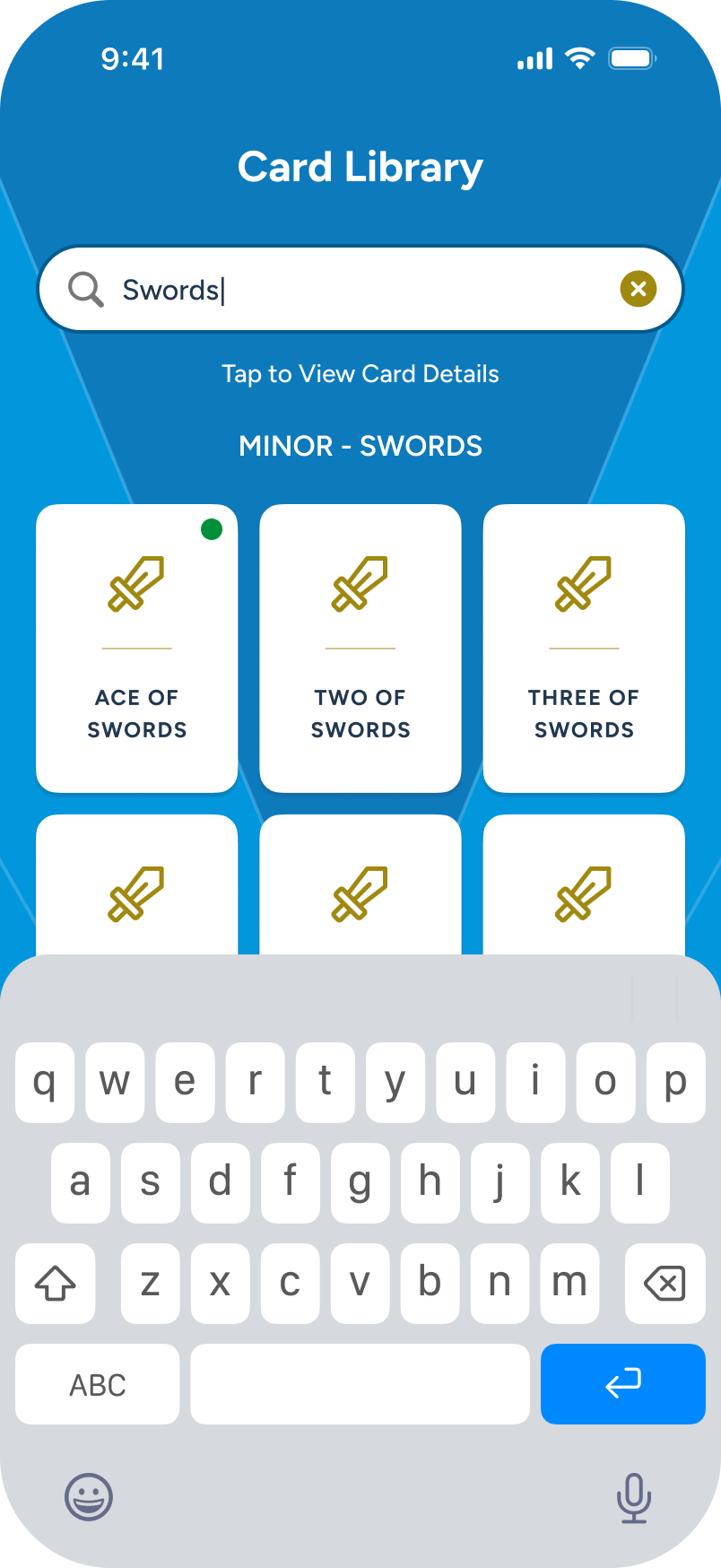
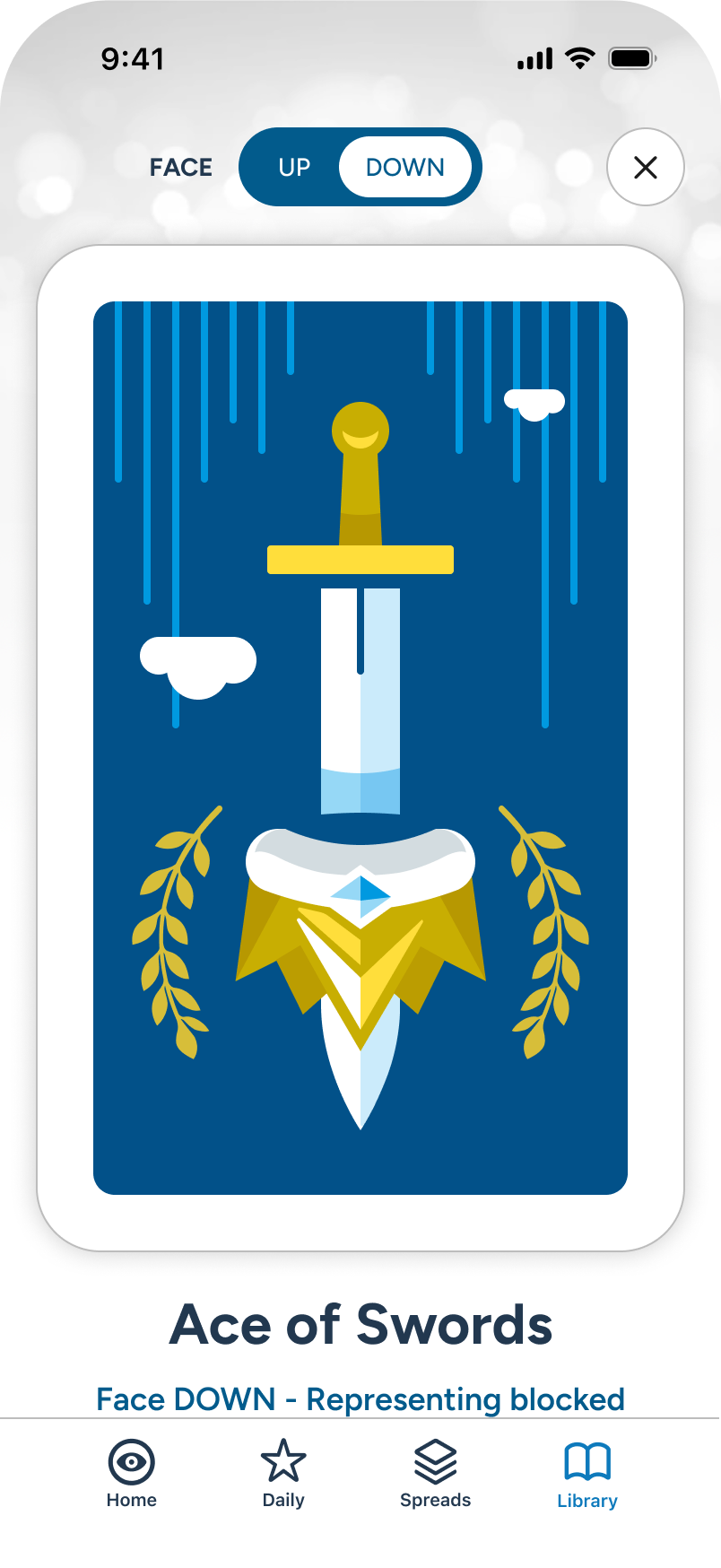
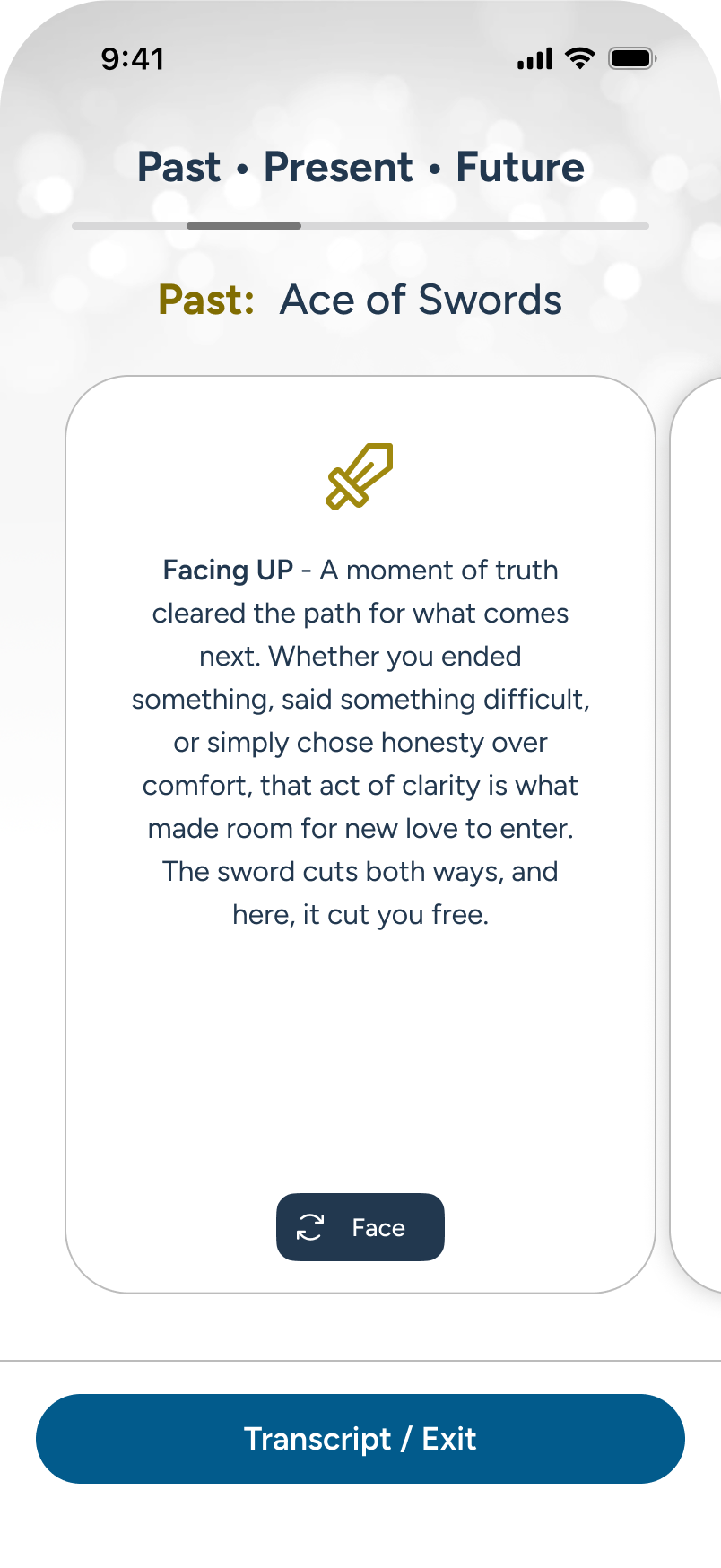
All users can access the Library to search the 78-card deck. In this example, a user searches for and reviews the Ace of Swords.

The user visits the Library from the tab bar to review card meanings.

With many cards to swipe through, the user decides to tap the search field instead.

Searching for "swords," the user sees all of that Arcana appear.

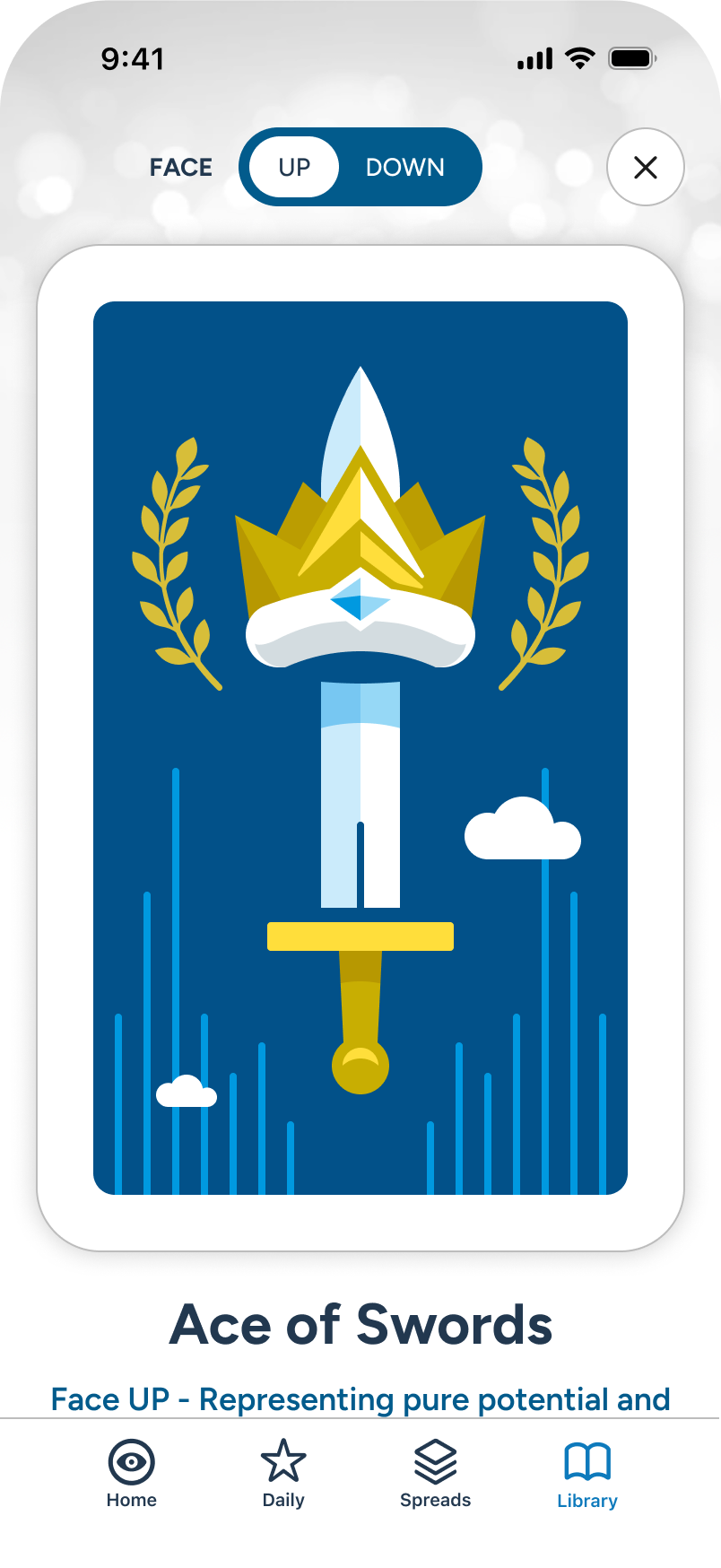
The user taps the “Ace of Swords” small card to review its meaning

Face UP / Face DOWN

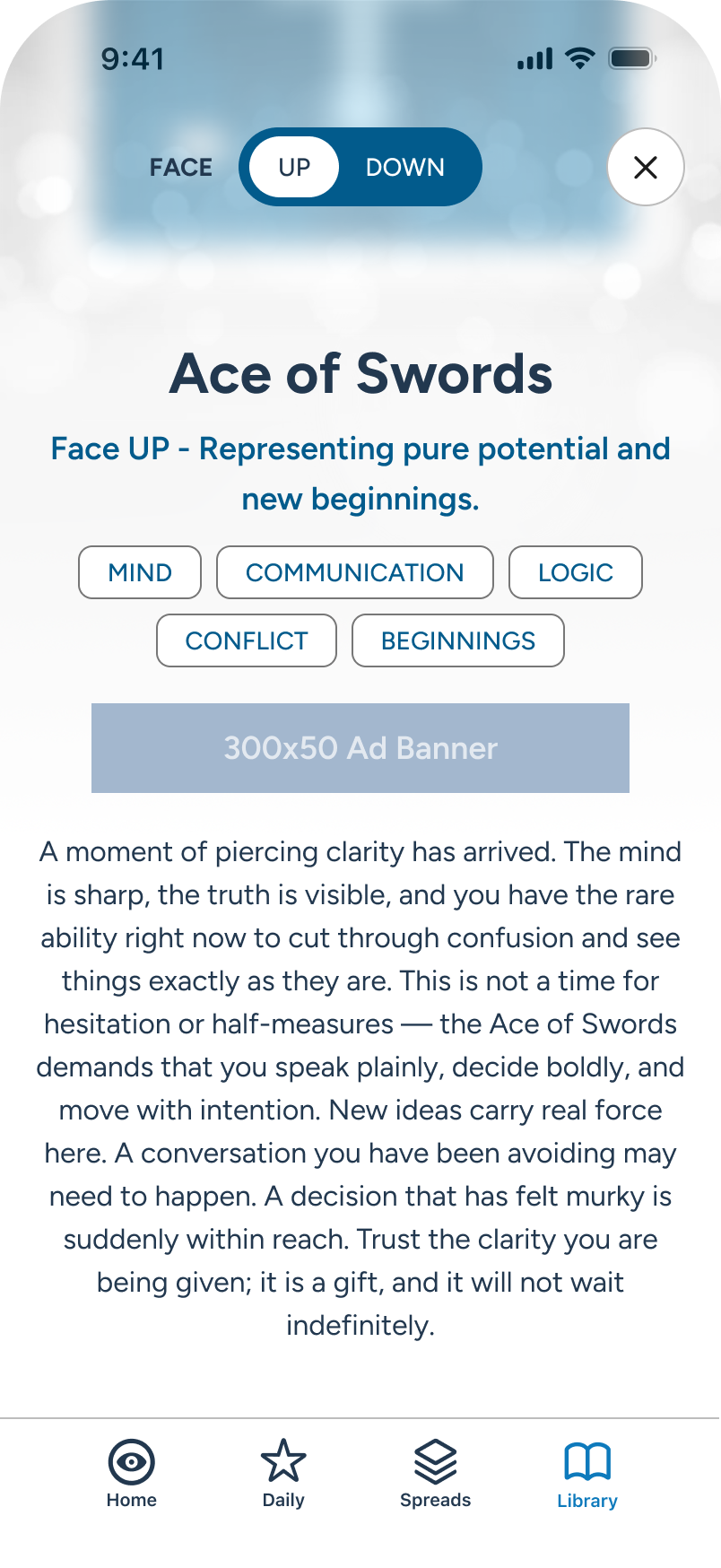
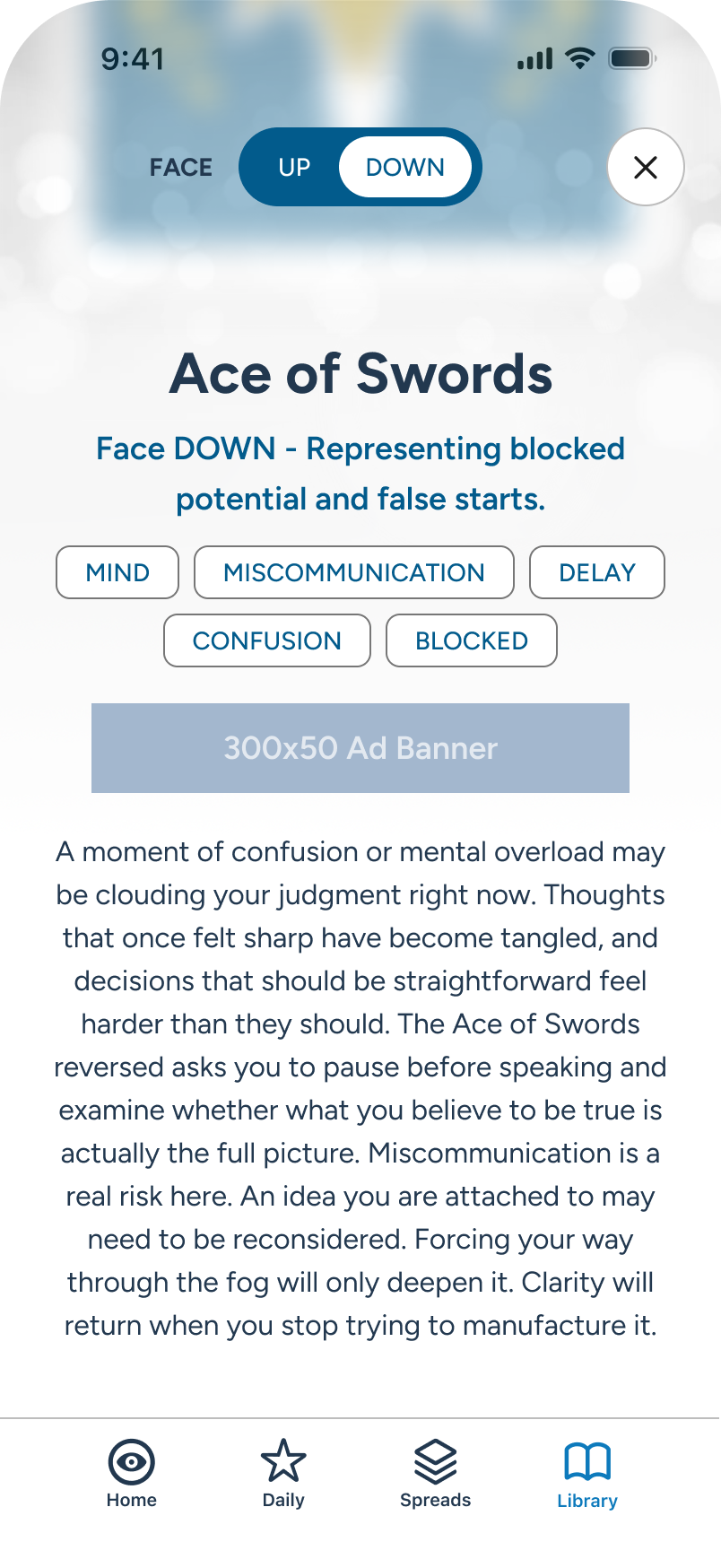
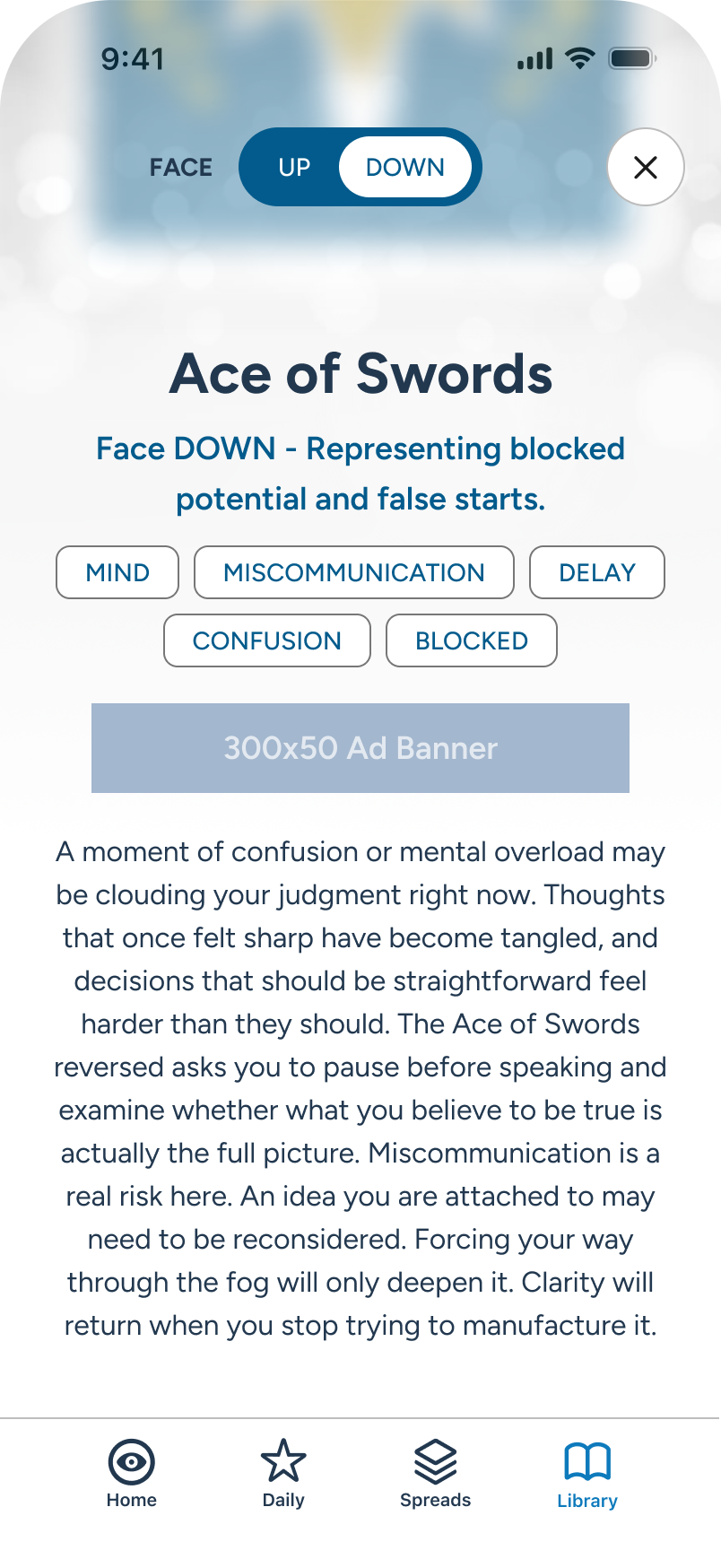
Regardless of reversal enablement on Home, all users can toggle between Face UP / DOWN (or reversed) meanings under the Library.

The user reviews the Face UP card, swiping up to reveal details.

The user reviews the full details for the current card in the upright position.

Returning to top, the user taps the down toggle, and the card and details invert, or flip.

The user is now reviewing the inverted details for the card in focus.

Error: No Internet

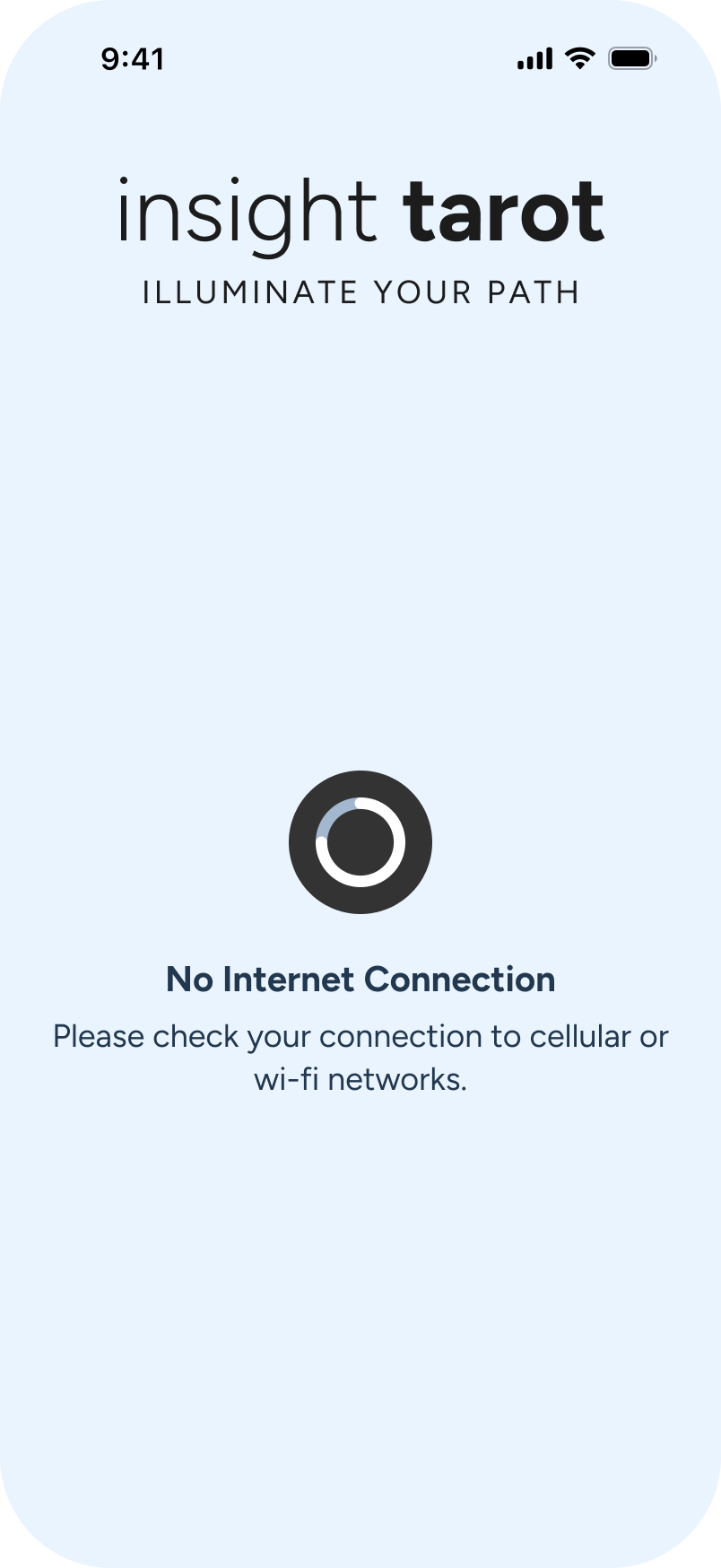
Cellular or Wi-Fi issues can happen at any time. For MVP, a simple full-screen overlay informs the user of the outage. The slow-moving spinner indicates an active search while the messaging prompts the user to check their hardware connection. Once reception is restored, a global “You’re Back Online” banner appears at top of screen, then disappears within seconds.

Note: A post-mvp solution may see a granular disablement of features during outage, like the advanced AI-assisted Spreads, while maintaining access to hard-coded information like the Library and Daily Guidance (TBD).

The user is browsing the application...

Internet OFF. An overlay appears. A spinner suggests active search while the text guides user to action in OS.

Connection restored. A global banner appears at top for a few seconds and the user continues on.

Post-MVP Considerations

With a solid foundation in place, there's meaningful room to grow. Here are a few considered next steps.

Settings / AI Personas

Subscriber Only: Consider the ability to select from a number of predefined virtual readers which can help shape the multi-card readings through their unique characteristics.As an AI-first product, there are no plans to support live readers

AI Reader - Ask a Question

Subscriber Only: The current model gives users autonomy and ritual in selecting their spread and cards. A near-future addition is a dynamic conversational mode for turn-by-turn automated readings, which will also benefit from AI Personas. Together, both options serve different demographics equally -- classic ritual for purists, conversational mode for those who want fast answers.

Additional Multi-Card Readings

Subscriber Only: During MVP review, popular spreads above 8 cards, if abused, could incur too much monthly token usage against profit margin. Therefore, they will be gated behind a future elevated tier.

Feature Update Screens

For future releases, provide a “Whats New” checklist on app open.

Settings / Audio + Language

  • Magical sound effects for key interactions, with on/off.
  • Optional AI voice playback of readings.
  • Support languages in projected growth markets.

Granular “No Internet” Access

While kept to a simple outage screen for MVP, a future solution may see a granular disablement of LLM-related features, allowing Daily Guidance and Library to still be accessed off-line.

Merchandise + Promotion

  • Explore publishing the app’s custom deck for real-world use.
  • Consider an Etsy store, or similar, for artwork resold as posters, apparel, and more, and link back to the app.
  • Review ways to promote the app beyond the App Store.

Post-MVP User Tiers

Projected breakdown -- a work in progress. A scaled-back version of this will be used for first release.

Basic

$0

With Ads

Core freemium features:

  • Daily Guidance (single card) with optional lock screen delivery
  • Library search& details (78-card deck)
  • Card reversals
  • Sound effects and audio settings
  • Multi-language / region support

Premium look, with access to the custom card deck, without the subscription price.

Insight Plus

$5

With Ads

Everything in Basic, including:

  • Access to 8 multi-card spreads with AI-generated summaries
  • Multi-card spread favouriting (custom Home pinning)
  • Emailed transcript option

Premium features at below-market pricing to drive conversion.

Premium

$7+

Ad Free

Everything in Plus, including:

  • Ad-free experience
  • AI reader selection (to shape reading voice and outcome)
  • Ask a Question - AI chat
  • Voice playback of readings
  • Themes and different card decks

Competitive pricing on lower end of market ($8-22/mo). Accessible upgrade, driving conversion over competitors at 2-3x cost.

Astrology & Divination Apps: 2026 Market Summary

Market Size & Growth

$9B by 2030

from $3B in 2024

20%

CAGR

User Base

120M+

Monthly Active

25-35%

Subscription Adoption

60%

Gen Z/Millennials

ARPU - Average Revenue Per UserCAGR - Comp. Annual Growth RateAll dollar figures in USD. Data sourced from 2024-2025 market reports; citations verified through Claude AI extended research.

AI Adoption Surge

2025

47%

AI-Enabled Personalization

58-62%

Users prefer hyper-personalized insights that AI can provide

10-18%

Improved Retention

Revenue Mix

Freemium/Ads

50%

Subscriptions

30%

Live Consult

20%

Subscriptions

$8-22/mo

Per User

Market Size & Growth

N. America

40M+

Users

Highest ARPU

Asia-Pacific

40-50%

Downloads

Growing

India

+49%

CAGR

Fastest

EU

25-35%

Subscribe

Steady Growth